
Booking.com App Localization
Adapting the experience to Chinese user expectations.
Background
This was an independent client consulting project for a third party, focused on how Booking.com could better adapt to the Chinese market.
As travel spending grew in China, the online travel market became increasingly competitive. Booking.com had entered China years earlier, but its market share remained limited compared with stronger local online travel platforms.
This project examined how a more localized app experience could help Booking.com better fit Chinese users' expectations around information discovery, payment, social sharing, customer support, and core booking flows.
Problem Discovery
To identify the main localization gaps, I combined market research, competitive analysis, product-pattern comparison, survey responses, and user interviews. I looked beyond the Booking.com app itself to understand how Chinese users were already discovering, comparing, booking, paying for, and sharing travel services through local platforms.
The research drew on five sources:
- Industry reports: reviewed 6 reports on online travel to understand China's online accommodation market and Booking.com's market position.
- Mobile app pattern comparison: compared 5 leading Chinese apps, including WeChat, QQ, Taobao, Baidu, and Alipay, alongside major U.S. apps in similar use cases to understand differences in mobile interface patterns, interaction habits, and service expectations.
- Local travel-platform analysis: selected 4 local competitors, including Ctrip, Qunar, Feizhu, and Meituan, four major Chinese travel and local-services platforms, for deeper competitive analysis.
- Survey responses: collected 164 valid responses from an online survey. The age distribution was broadly aligned with China's broader internet population, which helped make the findings more representative.
- User interviews: interviewed 3 users who had booked hotels online to better understand pain points in real booking scenarios.
This research surfaced six key localization gaps:
- Low brand awareness: My survey showed a clear awareness gap among users who had booked hotels online: only 46.3% recognized Booking.com, while 95.1% knew Ctrip, China's leading online travel platform. For many Chinese users, Booking.com was still far from being a default choice when planning and booking travel.
- Weak in-app engagement and promotion model: In China's travel market, local platforms rely heavily on in-app content, destination guides, seasonal campaigns, deals, and other promotional surfaces to keep users engaged and move them toward booking. Compared with local competitors, Booking.com had a much lighter in-app presence, with fewer content-driven touchpoints, less frequent promotions, and weaker visibility for marketing and conversion-oriented modules.
- Limited local payment support: Booking.com did not support Alipay and WeChat Pay, the dominant mobile payment methods Chinese users were already accustomed to. In my survey, among users who had booked hotels online, 49.1% said local payment options were one reason they chose domestic travel platforms over Booking.com.
- Customer support did not match local expectations: Chinese users were accustomed to resolving travel issues through real-time in-app support or direct phone support, especially when bookings involved hotels, schedules, or payment problems, while Booking.com relied more heavily on email-based communication. In my survey, among users who had booked through Booking.com, 50% said inconvenient customer support was an area that needed improvement.
- Interaction-pattern and usability gaps: Several core interactions in the Booking.com app felt less aligned with Chinese users' established mobile habits. Searching by hotel name required too many steps, filtering did not match common local expectations, loading felt slow, and key information was harder to scan than in competing products.
- Missing local sharing options: the app lacked sharing options for WeChat, QQ, Qzone, and Weibo, making it harder for users to share hotel information or promotions with friends and family.
Solutions
The redesign was framed as an ideal localized experience, not just a UI fix. It gave the client a clearer direction for how Booking.com could compete in China and where deeper investment was needed across customer support, local payment, content, and promotion. Within that direction, I focused on the interaction, usability, and local-habit issues where design could make the most immediate difference.
1. Localized App Structure and Brand Presence
The concept explored a more localized app structure for Booking.com in China, where travel platforms relied heavily on content, promotions, customer support, and direct communication to build user trust and drive conversion.
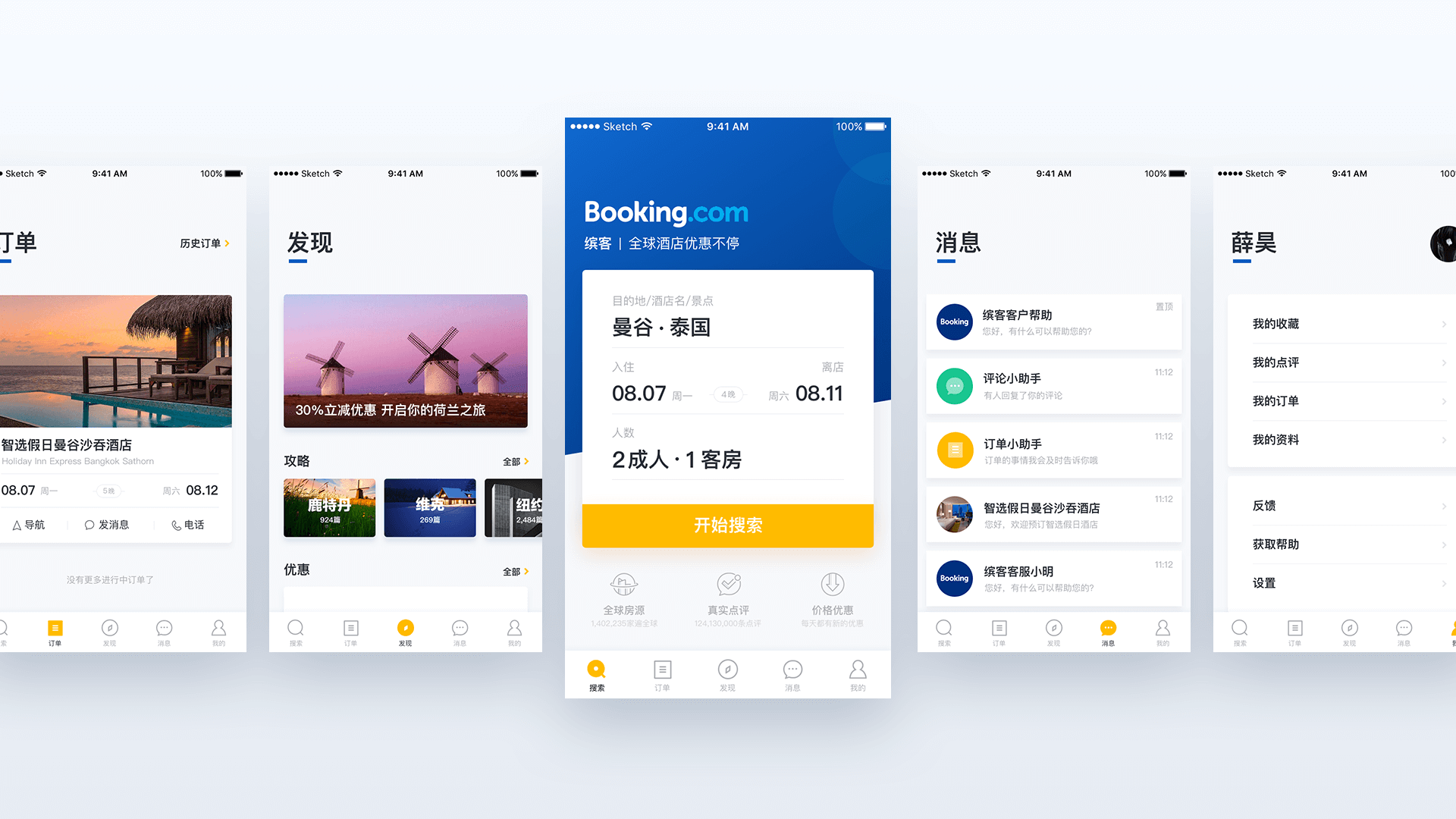
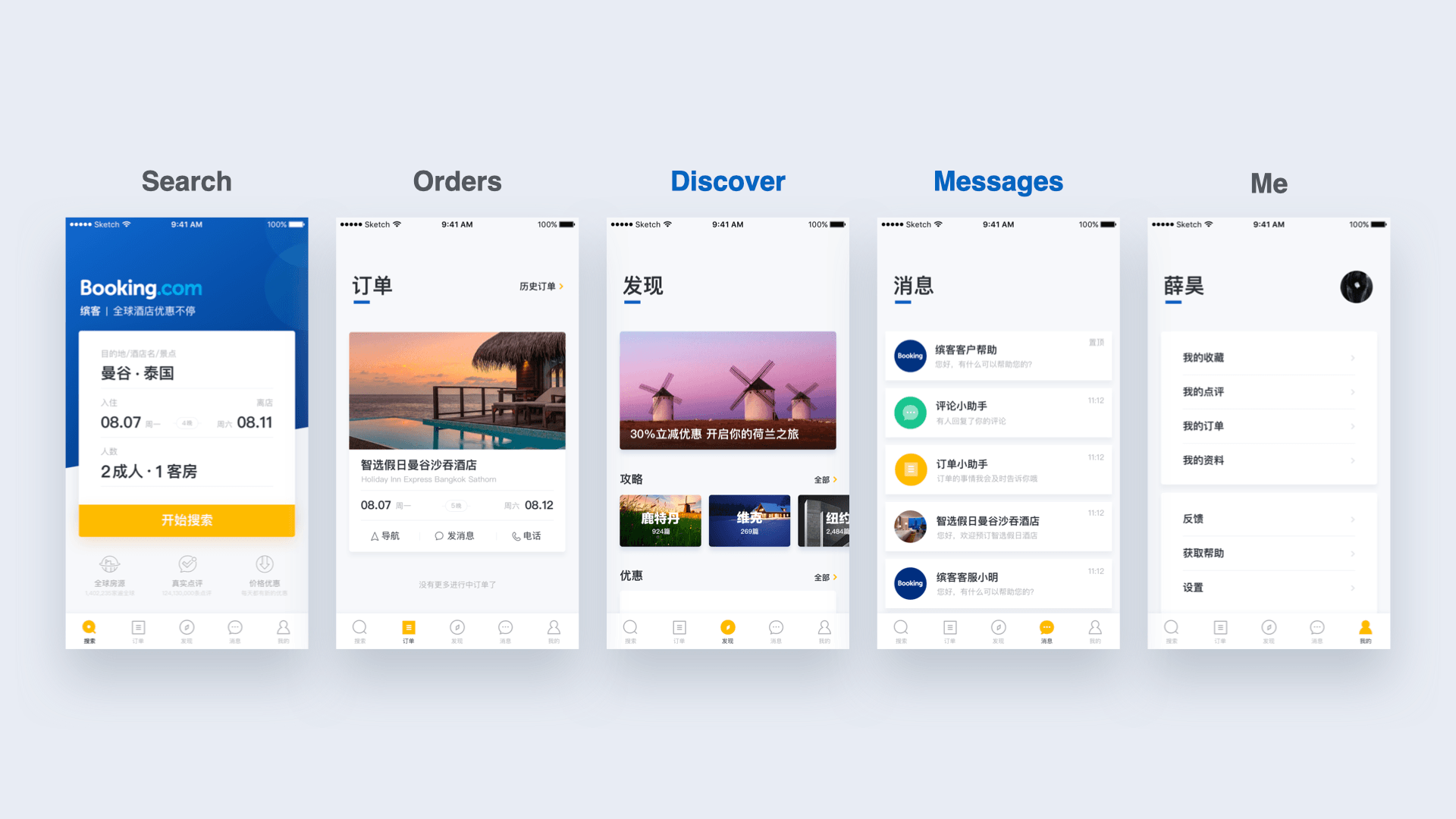
I redesigned the bottom navigation from Search, Bookings, Profile, and More into Search, Bookings, Discovery, Messages, and Me. Discovery became a primary entry point for travel content, destination guides, campaigns, and promotional modules, giving the product a clearer place for content-led engagement and marketing operations. Messages became a dedicated entry point for customer service and hotel communication, addressing Chinese users' expectations for direct, timely support within the app.
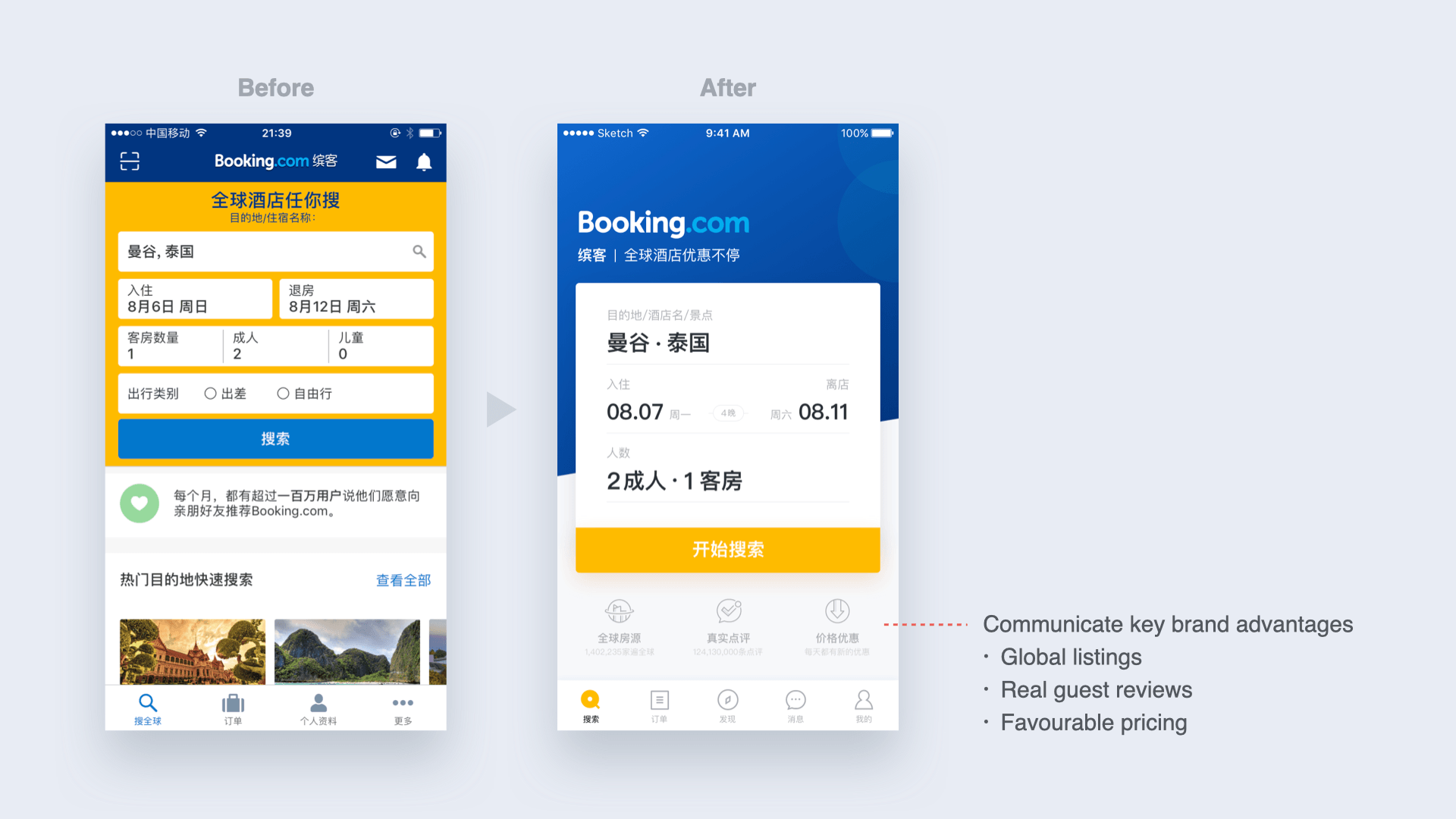
The homepage also needed to do more brand work. I strengthened Booking.com's presence in the first screen and made its core advantages more explicit, so users who were less familiar with the brand could quickly understand why they should consider it when planning and booking travel.
2. Localized Interaction Details for Core Flows
Search Experience Optimization
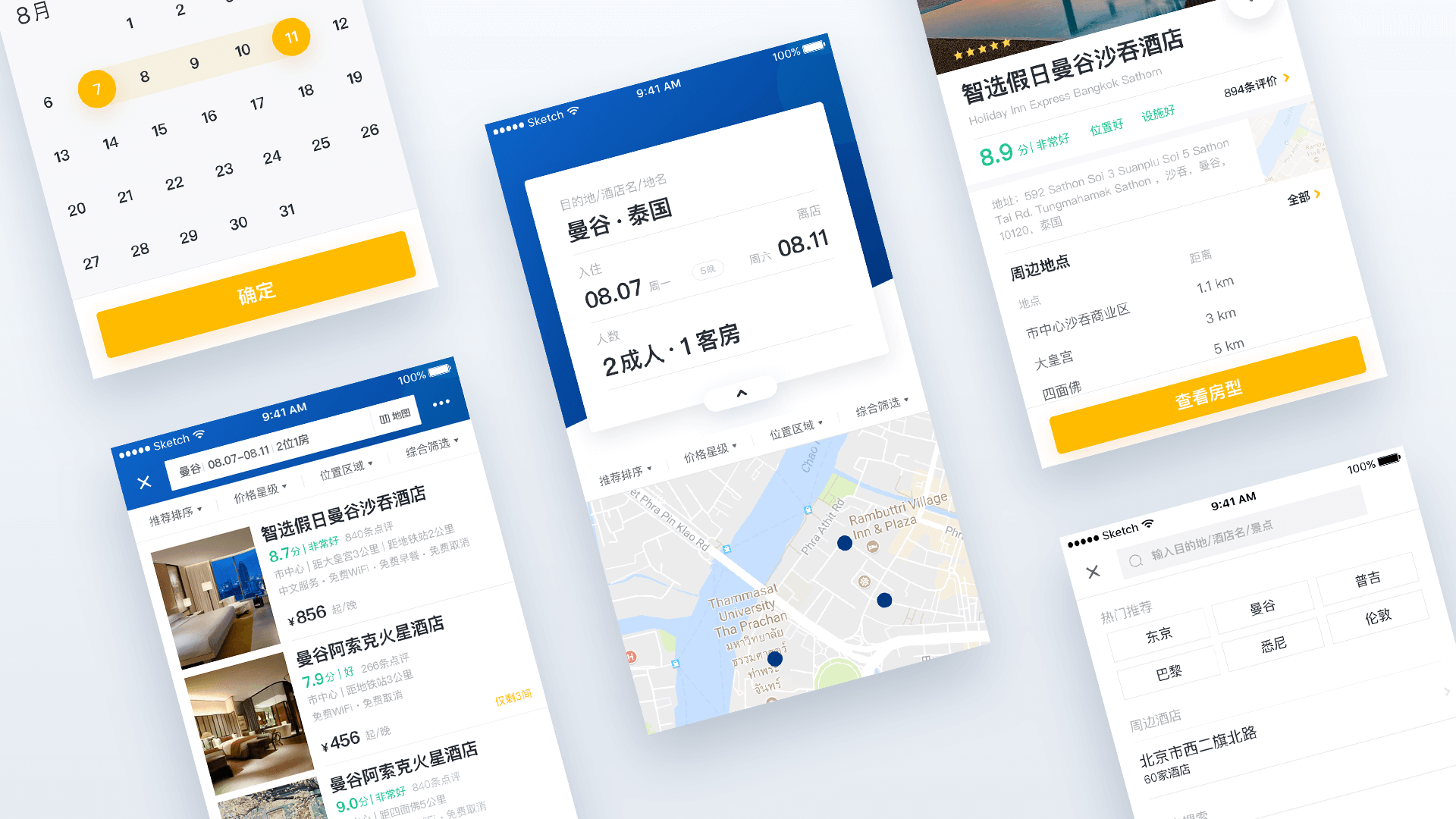
I simplified the hotel-name search flow from six steps to four, making a common search task faster and easier to complete.
I added an inline search-editing interaction, allowing users to modify search criteria directly on the results page without returning to the homepage.
I used motion design to make the loading experience during search feel faster and more natural.
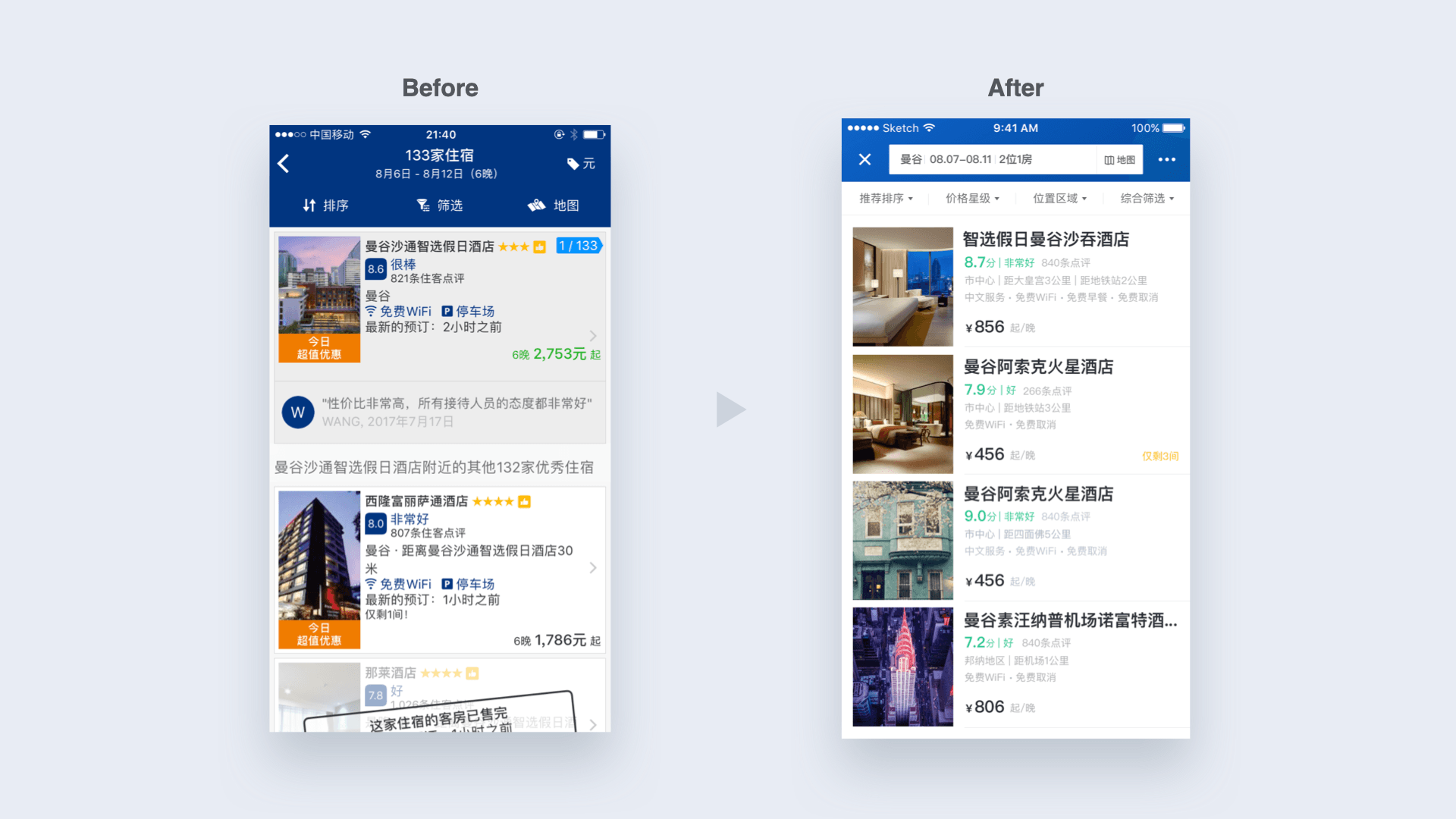
I also optimized the search results layout to better match Chinese users' browsing habits, making listings denser and clearer while making it easier to filter by different criteria.
Property Detail Page Readability and Interaction
I redesigned the property detail page around Chinese users' browsing habits, making key information easier to scan and allowing users to change booking dates directly on the detail page to check updated prices.

