
Baidu App
Designing a 200M-DAU search and content platform in China.
What Is Baidu App?
Baidu, the company behind Baidu App, operates China's largest search engine and was one of the first major Chinese technology companies to invest heavily in AI. Several researchers who later became influential in North American AI worked at Baidu, including Google Brain founder Andrew Ng, who served as Baidu's chief scientist, and Anthropic co-founder Dario Amodei, who conducted AI research there.
Baidu App is Baidu's flagship consumer mobile product and the main consumer-facing surface for its search, content, and AI capabilities. At its peak, it reached roughly 700 million monthly active users and more than 200 million daily active users. Built around search and an algorithmic feed, it also supports short-form video, short-form dramas, web fiction, local commerce, AI assistants, and mini-apps, which are lightweight services that run inside the app. It has consistently ranked among China's largest mobile apps and is one of the country's leading all-in-one information platforms and super apps.
For a North American technology audience, the closest analogy is a combination of Google Search, Google Discover, YouTube Shorts, Google Assistant, and a platform for embedded mini-apps and services. Baidu App helps people find information through search, discover content through recommendations, access services, complete tasks, and interact with AI without leaving the app.
My Decade with Baidu App
I designed Baidu App throughout my ten years at Baidu, from 2013 to 2023. During that time, I helped shape its evolution from a mobile search entry point with tens of millions of daily active users into an all-in-one information platform serving more than 200 million daily active users across search, content, services, and AI. My own role evolved as well. I grew from a designer responsible for individual product verticals into a Design Architect who shaped overall product direction, planned experience architecture, led major cross-team initiatives, and built platform capabilities.
Looking back, Baidu App's evolution fell into two broad phases.
The first was a period of exploring growth opportunities from 2013 to 2017. As mobile internet adoption accelerated and the market expanded, Baidu App needed to test new product experiences and business use cases. I owned design for web fiction, homepage cards, and online-to-offline local commerce. My work expanded from individual screens to end-to-end user journeys, conversion, and product architecture.
The second was a period of platform strategy and growth beginning in 2017. As China's mobile internet market began moving into a mature, saturated phase, Baidu's mobile strategy started shifting toward a search-and-algorithmic-feed product model. As a Design Architect, I took on long-term ownership of the Baidu App homepage and major design initiatives spanning multiple product teams. My focus shifted to shaping product direction through design, establishing platform-level experience standards, and exploring the next generation of search.
The first phase grounded me in users, use cases, and growth. The second taught me how to make system-level design decisions across product strategy, user experience, data, business goals, and organizational dynamics. My Design Architect role became clearest in the second phase: moving a 200M-DAU homepage toward a feed-led model and driving measurable gains in engagement, content discovery, and revenue. The following sections walk through these two phases in detail.
Phase One - Exploring Growth Opportunities (2013-2017)
When I joined Baidu in 2013, China's mobile internet market was growing rapidly. Smartphone adoption was expanding the mobile user base, while the mobile internet was reshaping content, commerce, and local services, creating a wave of new users and business opportunities. Technology companies were moving quickly to capture these emerging opportunities. While protecting its core mobile search business, Baidu App also needed to find new avenues for growth and evolve beyond a browser-like search tool into a product that could support a broader range of content and services.
In this phase, I owned design across initiatives that explored new growth opportunities and strengthened the core search experience. The work spanned homepage cards and proactive discovery, content consumption, and local commerce. Together, these efforts extended the user journey from finding information to discovering relevant information, consuming content, accessing services, and completing tasks. Although the projects looked different, they were all exploring the same question: how could Baidu App grow from a search entry point into a complete information and services platform?
1. Homepage Cards: From Search Entry to Proactive Discovery
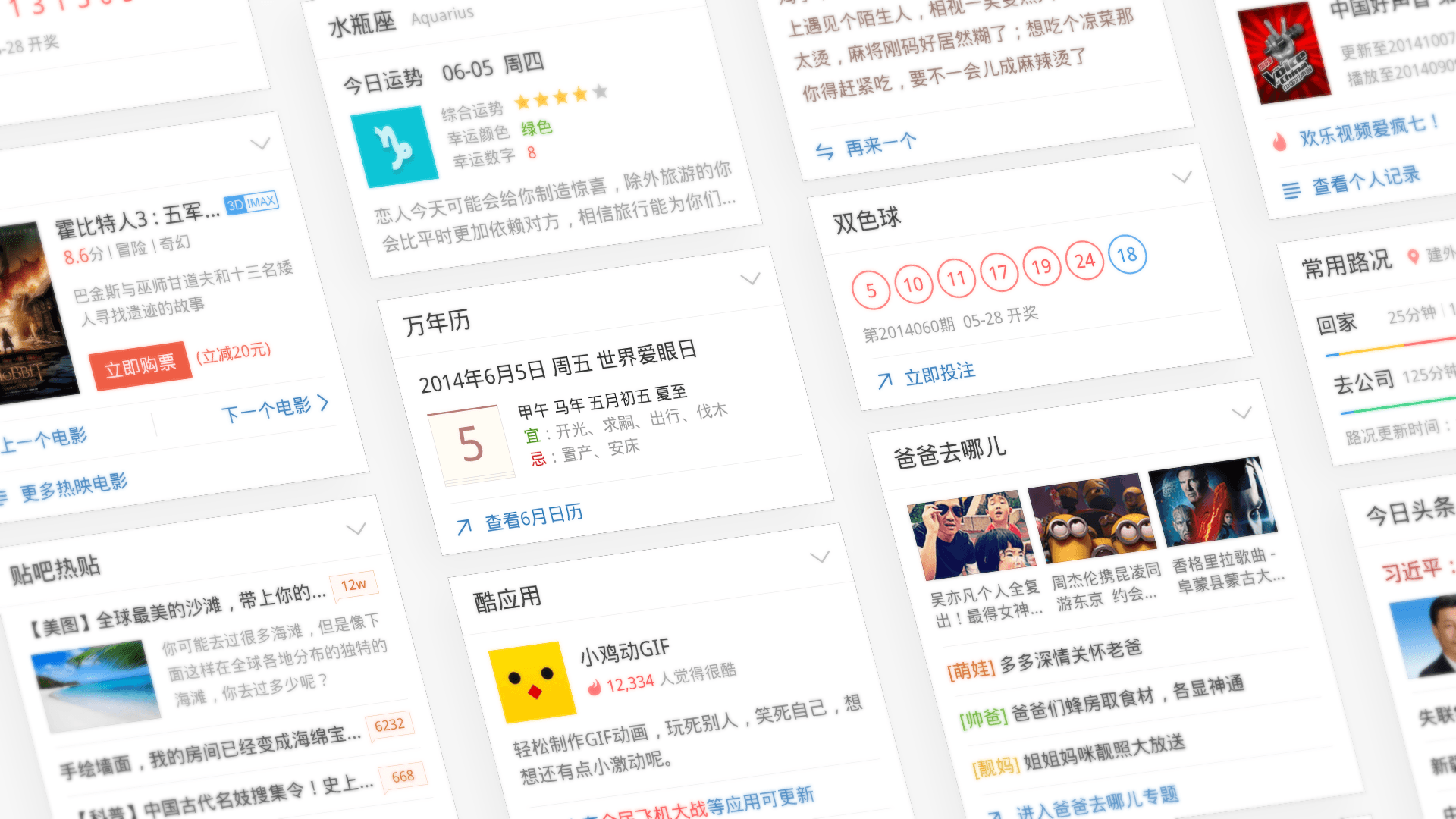
Traditional search depends on users actively expressing a need. Mobile devices, however, can provide richer context through location, time, past behavior, and the topics and interests users follow. This created an opportunity to rethink the Baidu App homepage: it could help users discover useful information and services before they formed a specific search query, while still preserving search as the primary entry point.
From 2014 to 2015, I led design for the Baidu App homepage and its contextual card experience. Similar to Google Now at the time, the redesigned homepage strengthened vertical service entry points and introduced a card-based stream alongside search, helping users access weather, commuting, content, and services based on geofencing, time, search history, and user interests.
The page needed to preserve search efficiency while making proactive discovery feel useful rather than intrusive. The cards had to present different types of information consistently and help users quickly understand why each item was relevant. This work helped Baidu App move from a user-initiated search entry point toward a homepage that could support more timely discovery and service access. It also provided early design learnings for the algorithmic feed that later entered the homepage.
2. Local Commerce: From Discovery to Transaction
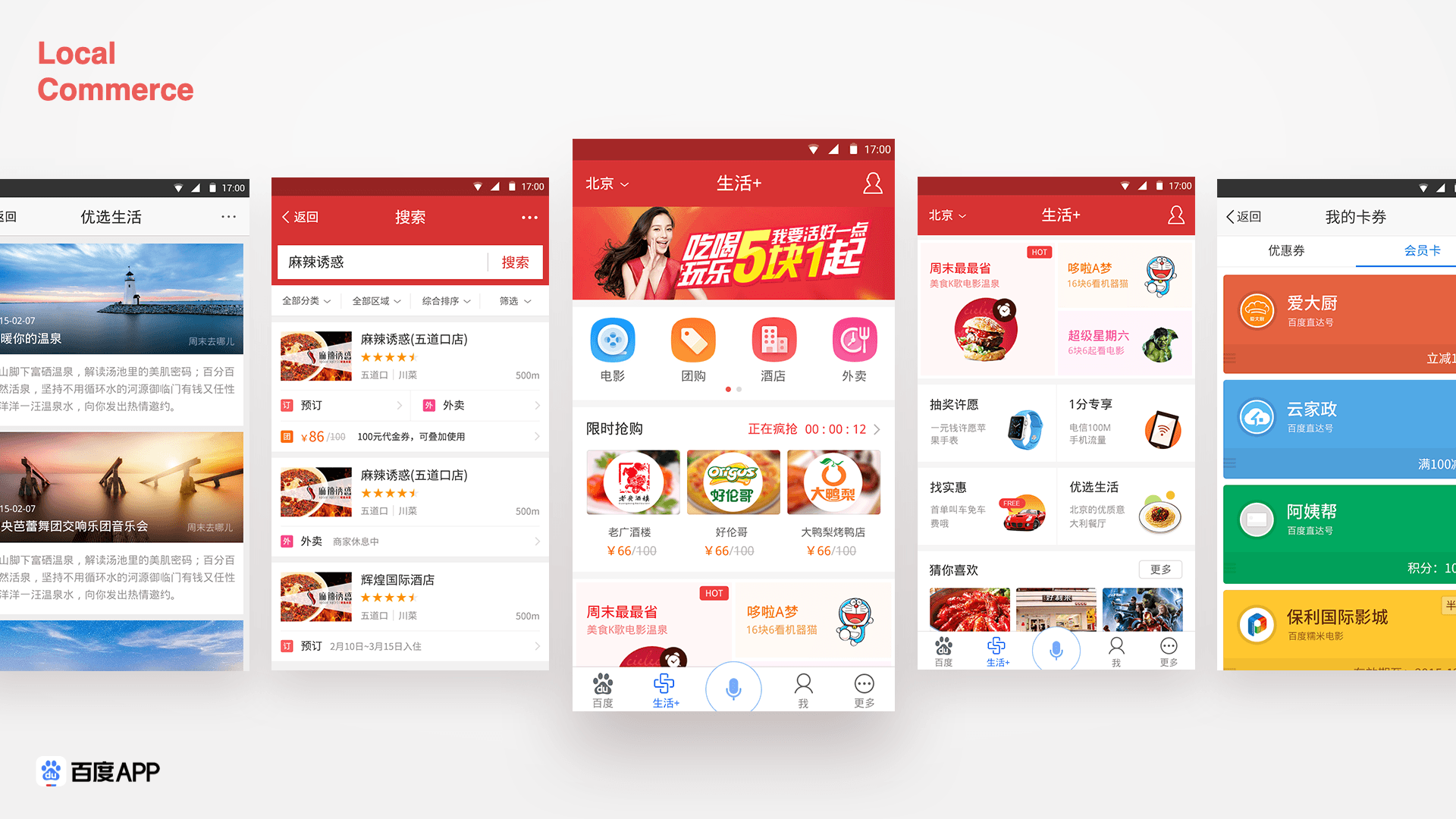
From 2015 to 2016, Baidu invested heavily in online-to-offline local commerce. Baidu App's goal expanded beyond helping users find merchant and product information. It also aimed to let users browse services, claim offers and benefits, evaluate their options, and complete transactions within the app.
I organized the design work into two tracks. One refined the end-to-end experience from entry points and service browsing to offer presentation, membership benefits, and completed transactions. The other strengthened in-channel campaigns, themed promotions, and seasonal visual treatments so design could directly support GMV growth. Because the journey from service discovery to transaction crossed multiple product teams, including Baidu Wallet, a PayPal-style digital wallet, and Baidu Nuomi, a Groupon-style local deals and services platform, I also drove several cross-product integrations. For example, we created a unified design system for merchant loyalty cards, ensuring that the same merchant's card appeared consistently across products in the Baidu ecosystem.
This work taught me to think about design at two levels: the end-to-end user journey and platform-wide collaboration. The experience needed to support the user's complete goal from service discovery through transaction, while enabling multiple teams to collaborate efficiently around a consistent experience. This moved my thinking beyond individual modules toward a more complete experience architecture.
3. Web Fiction: From Search to Reading
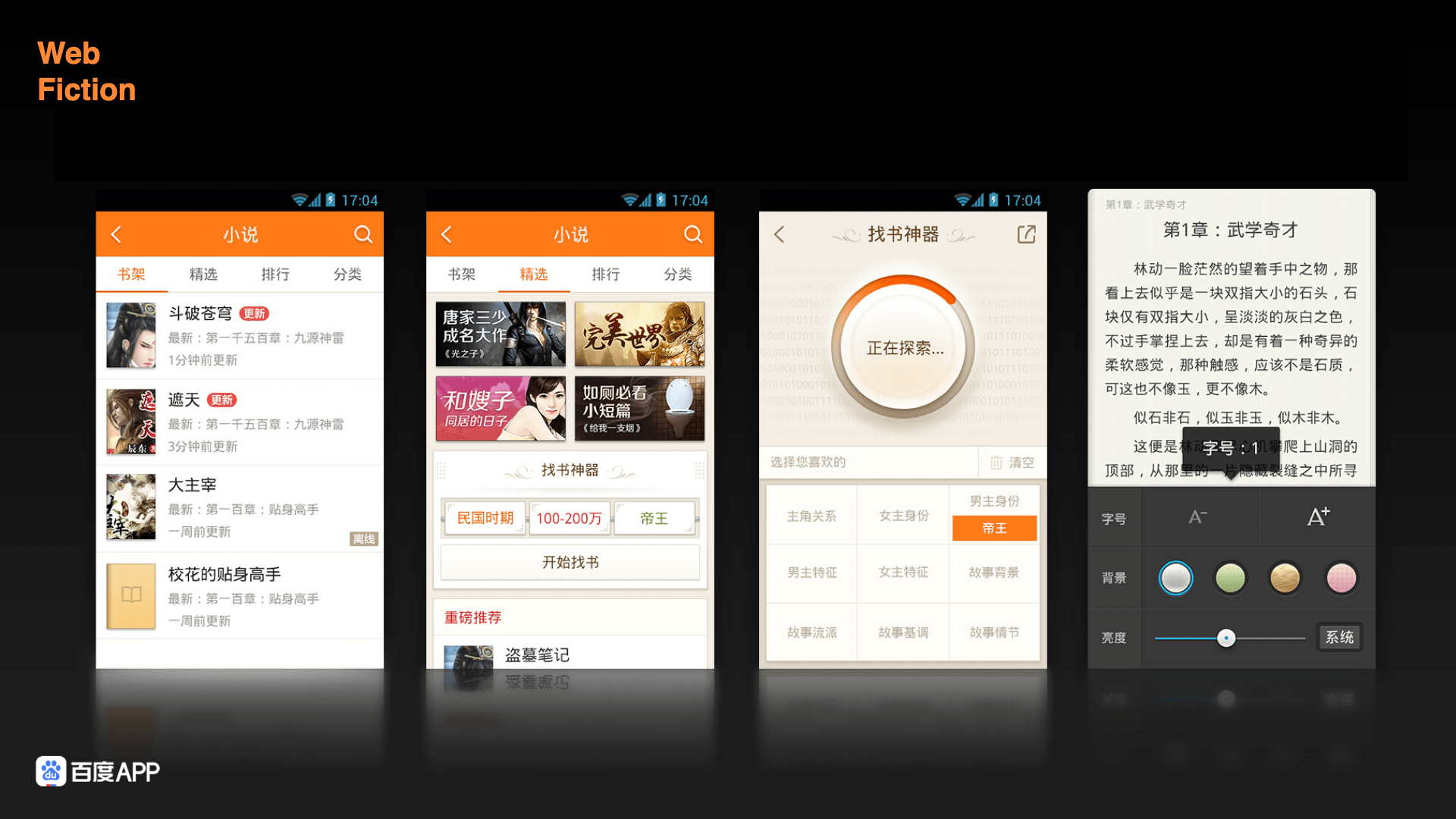
Web fiction was the first major product area I owned after joining Baidu and a standalone content vertical built within Baidu App. The experience needed to cover finding a title, choosing an edition, browsing the chapter list, reading comfortably without interruption, and following serialized updates over time. It could not stop at search results.
I reorganized the complete journey around two core jobs: finding titles and reading. The flow extended from search results and other entry points through book details, chapter lists, and the reading view, making titles easier to find and creating a more immersive reading experience. The product reached several million users in its first week and became one of Baidu App's fastest-growing verticals at the time. It also established the experience foundation for the web fiction business to become independently profitable through paid reading, memberships, advertising, and content distribution. Web fiction remains an important content business within Baidu App today.
Phase Two - Platform Strategy and Growth (2017 Onward)
After 2017, China's mobile internet market began shifting from rapid user acquisition to competition within a maturing, saturated market. As content platforms grew, user attention became scarcer. At the same time, more information became locked inside mobile apps, eroding traditional search's advantage in indexing the open web. Despite its enormous user base, Baidu App needed to better connect search, content, services, and monetization. The goal was to create a connected product ecosystem spanning information discovery, content consumption, service access, and transactions, while sustaining growth in a more competitive market.
In this phase, my role expanded beyond individual product verticals to shaping how the broader product should evolve. I drove work across three areas: a series of homepage redesigns that rebalanced search and the algorithmic feed; exploratory design that tested new product possibilities; and shared platform capabilities that turned proven approaches into reusable systems while maintaining experience quality and delivery efficiency at scale. This required more than design craft. I had to make tradeoffs across user experience, product growth, and monetization, align multiple product teams, and build support from senior leadership for key decisions and resource commitments.
1. Homepage: Rebalancing Search and the Algorithmic Feed
The Baidu App homepage is the product's most important and sensitive surface. It must preserve the speed and clarity of search while supporting content discovery, user retention, and monetization. Even a small change can affect hundreds of millions of users and multiple product teams.
Setting the Direction: Elevating the Algorithmic Feed on the Homepage
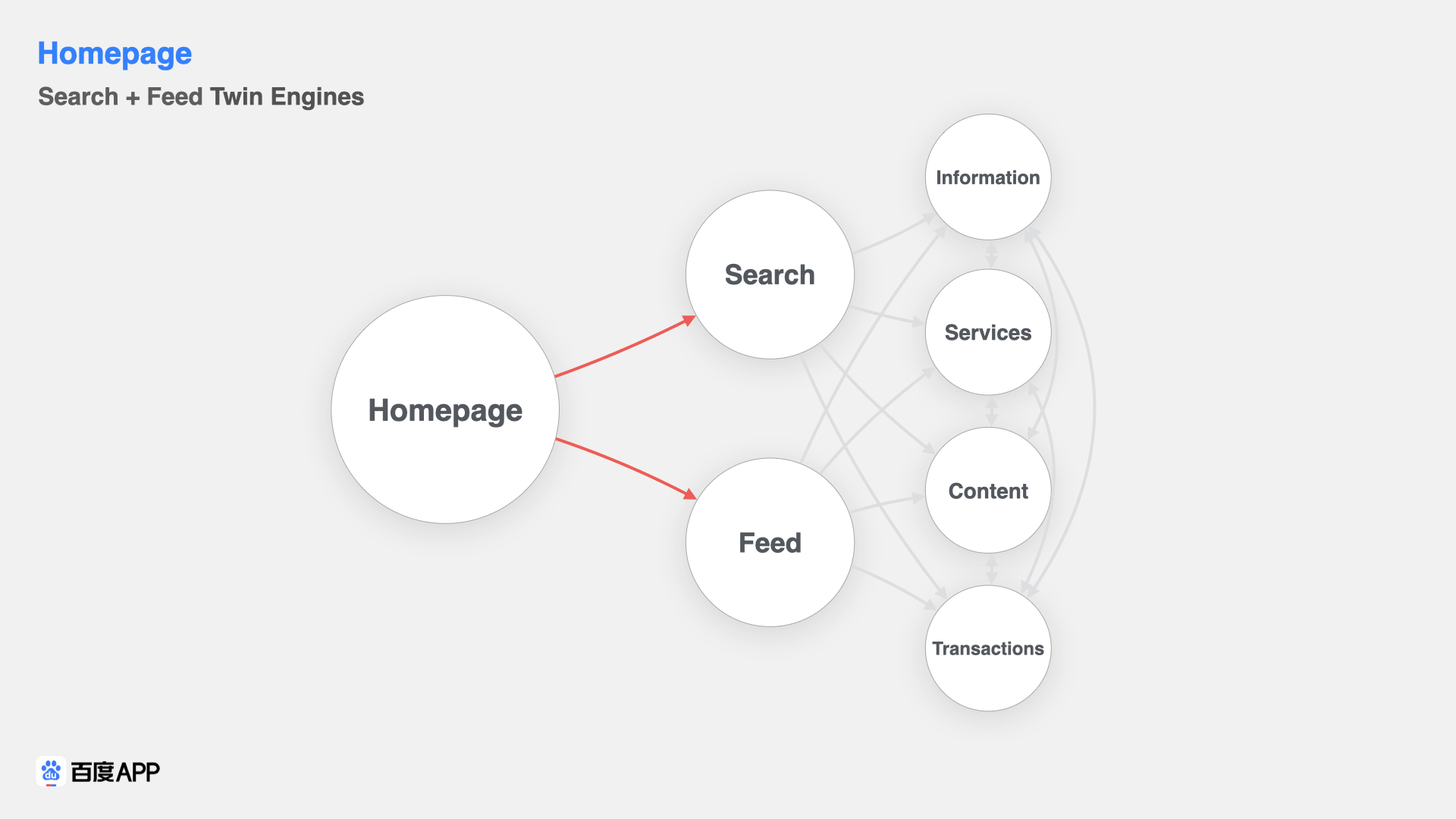
As the market matured, time spent and effective content distribution became increasingly important. My judgment was that algorithmic feeds had already proven themselves as a core mobile product pattern. The Baidu App homepage needed to move beyond a search-primary, feed-secondary structure and give the algorithmic feed greater prominence.
Search remained the product's foundation. The opportunity was to give the feed, a mode of information discovery better suited to mobile behavior, more space and visibility so Baidu App could compete more effectively for retention and time spent in a saturated market. The design needed to preserve search efficiency and users' established mental model of Baidu as a search product, while making the feed more compelling and easier to discover. The homepage also had to remain clean and orderly.
Approach: Evolving a Mature Product Through Incremental Experiments
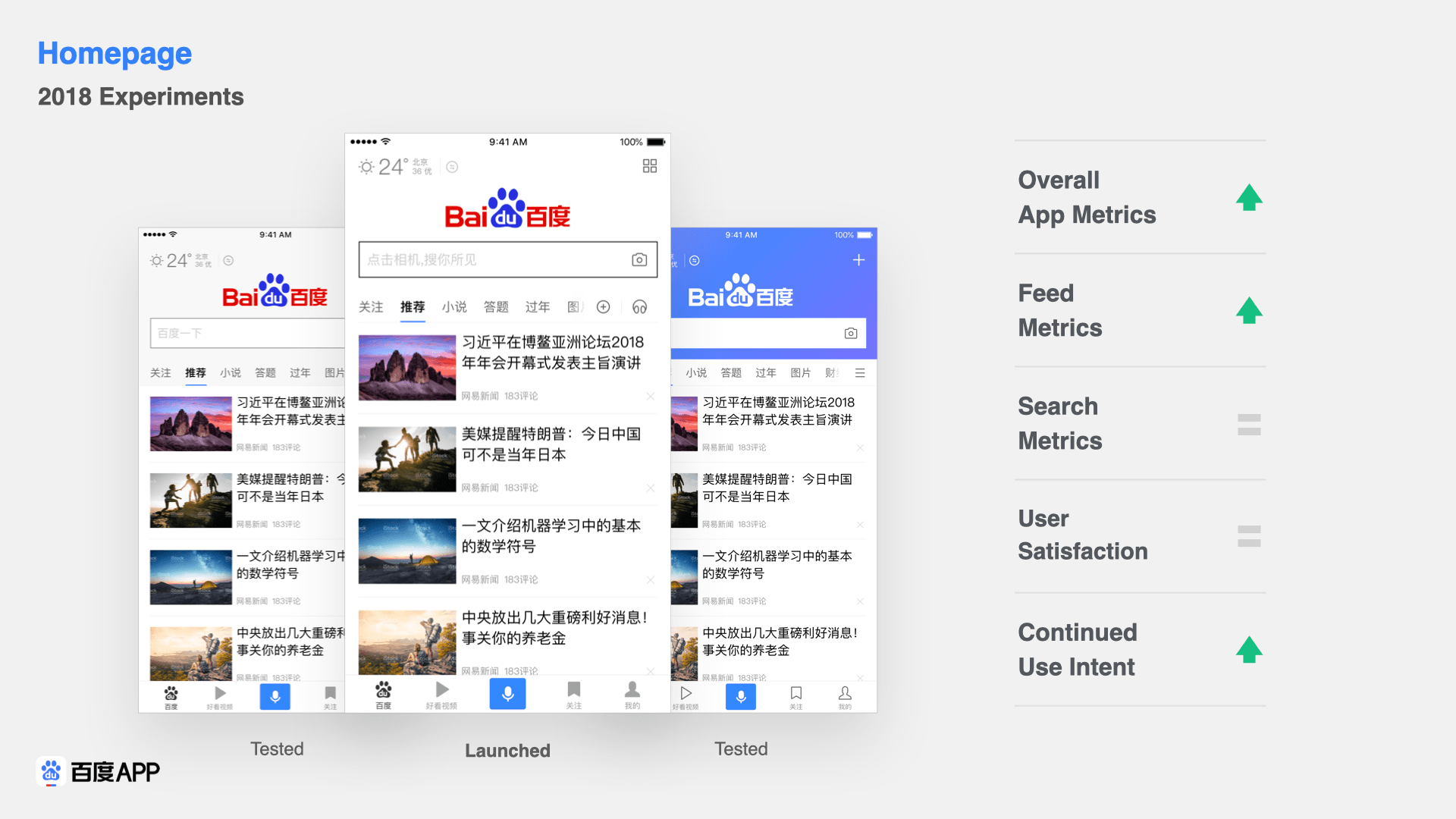
Products at this scale cannot be transformed through a single aggressive redesign. Because the homepage connected search, the algorithmic feed, monetization, and multiple product verticals, we first needed a clear long-term direction and cross-team alignment. We could then calibrate the experience through limited-traffic tests, reversal tests that swapped treatment and control groups, and continuous data-informed iteration.
From 2017 to 2020, I led three major homepage upgrades. Through rigorous experimentation and phased iteration, we gradually increased the feed's prominence and helped drive growth in daily active users, time spent, content distribution, and monetization revenue.
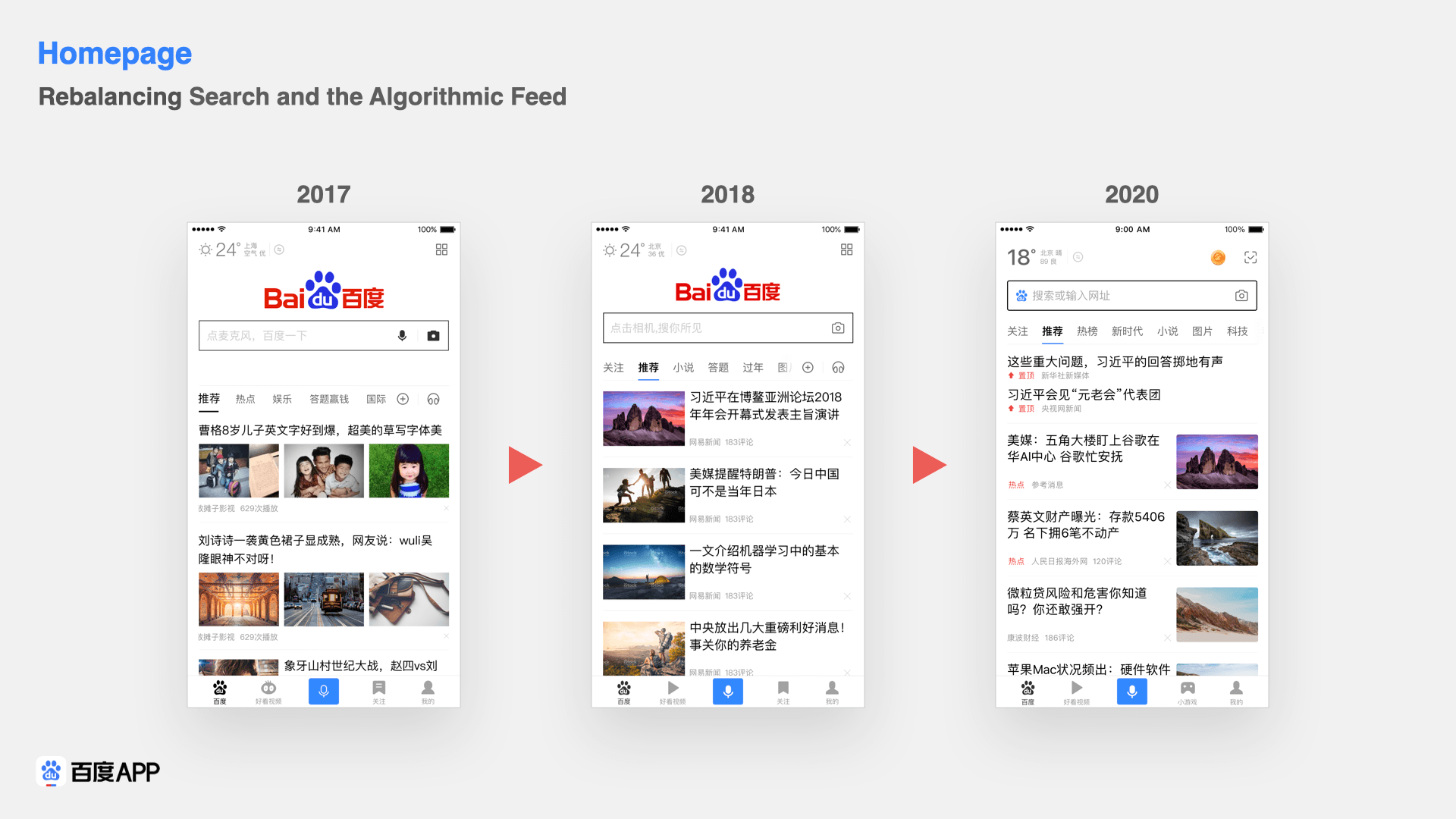
In 2017, we reduced the prominence of vertical service entries and expanded the feed, establishing a search-and-algorithmic-feed product architecture.
In 2018, we further rebalanced search and the feed, refined the visual hierarchy and information density, and increased feed usage and overall content distribution while keeping core search metrics stable.
From 2019 to 2020, I continued leading the effort to remove the large Baidu logo that had traditionally occupied the top of the homepage, making the feed the page's clearer focal point. Breaking with this long-standing convention took more than a year, from early research and project scoping through multiple rounds of limited-traffic tests, reversal tests, and detailed refinements. The work had to balance the needs of search, the feed, monetization, and multiple product teams while navigating the caution and inertia that come with major changes to a mature product. I held to the long-term direction while accepting interim compromises, using experimental data to build alignment over time. The homepage ultimately moved to a feed-led structure and produced positive results in both core metrics and user feedback.
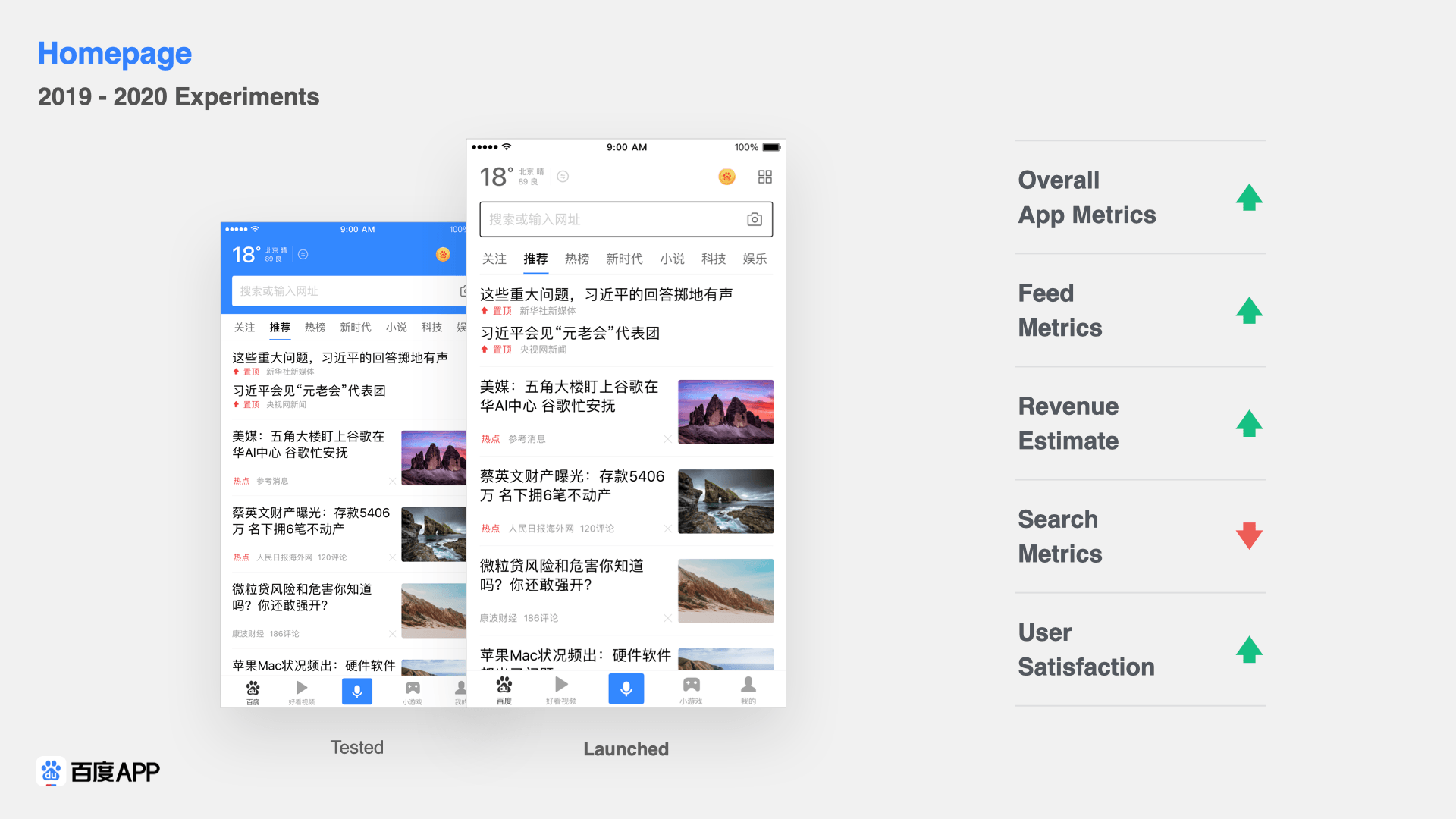
Results: Better User Experience, Stronger Feed Engagement, and Revenue Growth
Across several years, these redesigns preserved core search metrics while gradually expanding the feed's contribution to user growth, content distribution, and monetization.
The 2020 redesign drove gains in Baidu App daily active users, time spent, and overall distribution metrics. User research also found the new homepage cleaner and more organized. Based on multiple experiments, the data science team estimated that the redesign generated several hundred thousand RMB in incremental revenue per day, equivalent to more than RMB 100 million annually. The estimate carried some uncertainty because the data systems could not directly trace the path from homepage-level product metrics to final revenue. Even with that limitation, the gains in core metrics and positive user research provided strong evidence that the structural change created value across user experience, content distribution, and monetization.
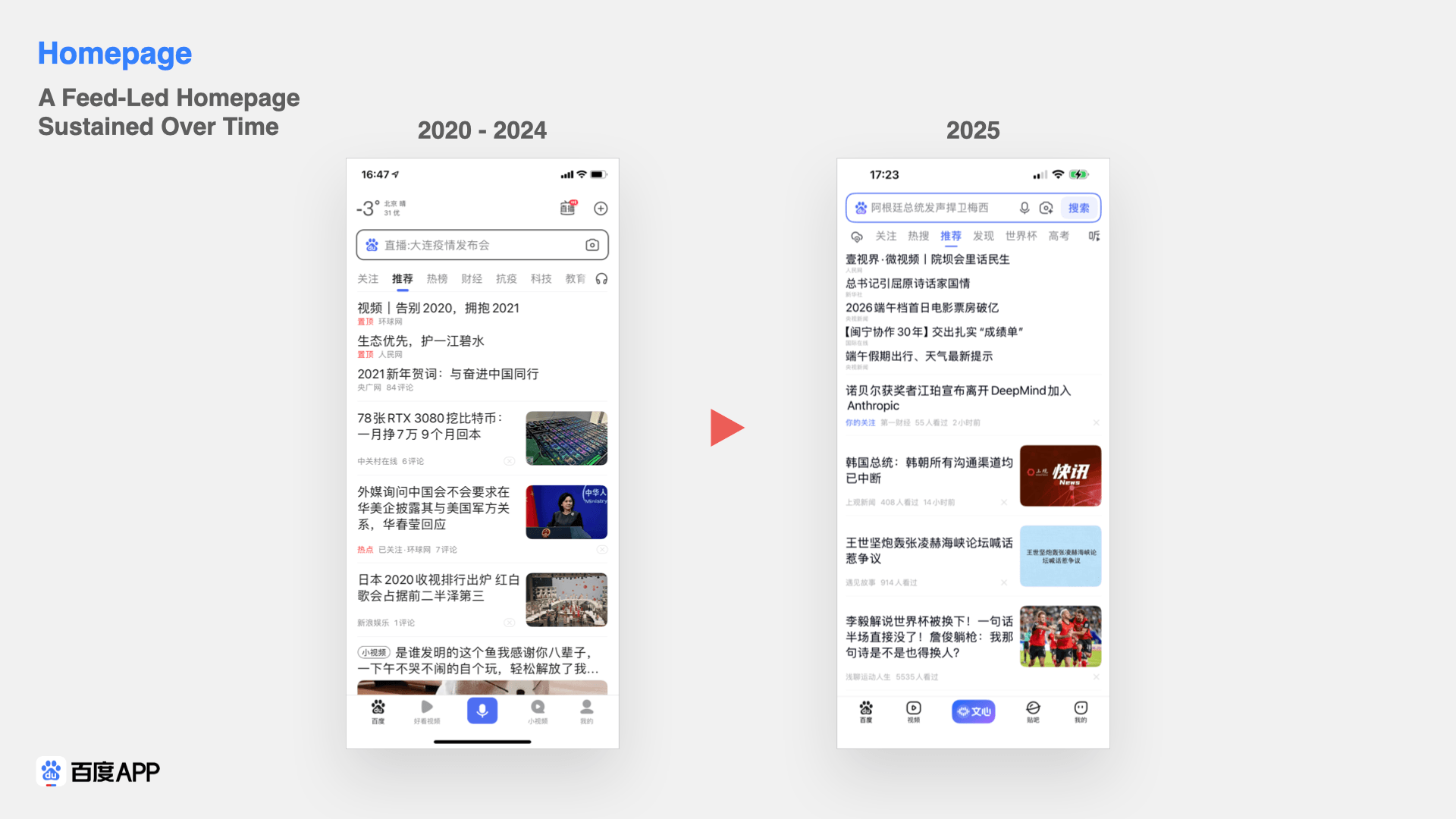
As of 2026, the Baidu App homepage continues along the same path. The search box now sits at the top of the page, leaving more space for the feed. The AI entry point remains in the original voice button, the same entry previously used for the Duxiaoxiao AI assistant, without changing the homepage's basic structure. This continuity offers longer-term validation of my judgment about the homepage's direction and the lasting value of this design path.
2. Exploratory Design: Testing New Possibilities
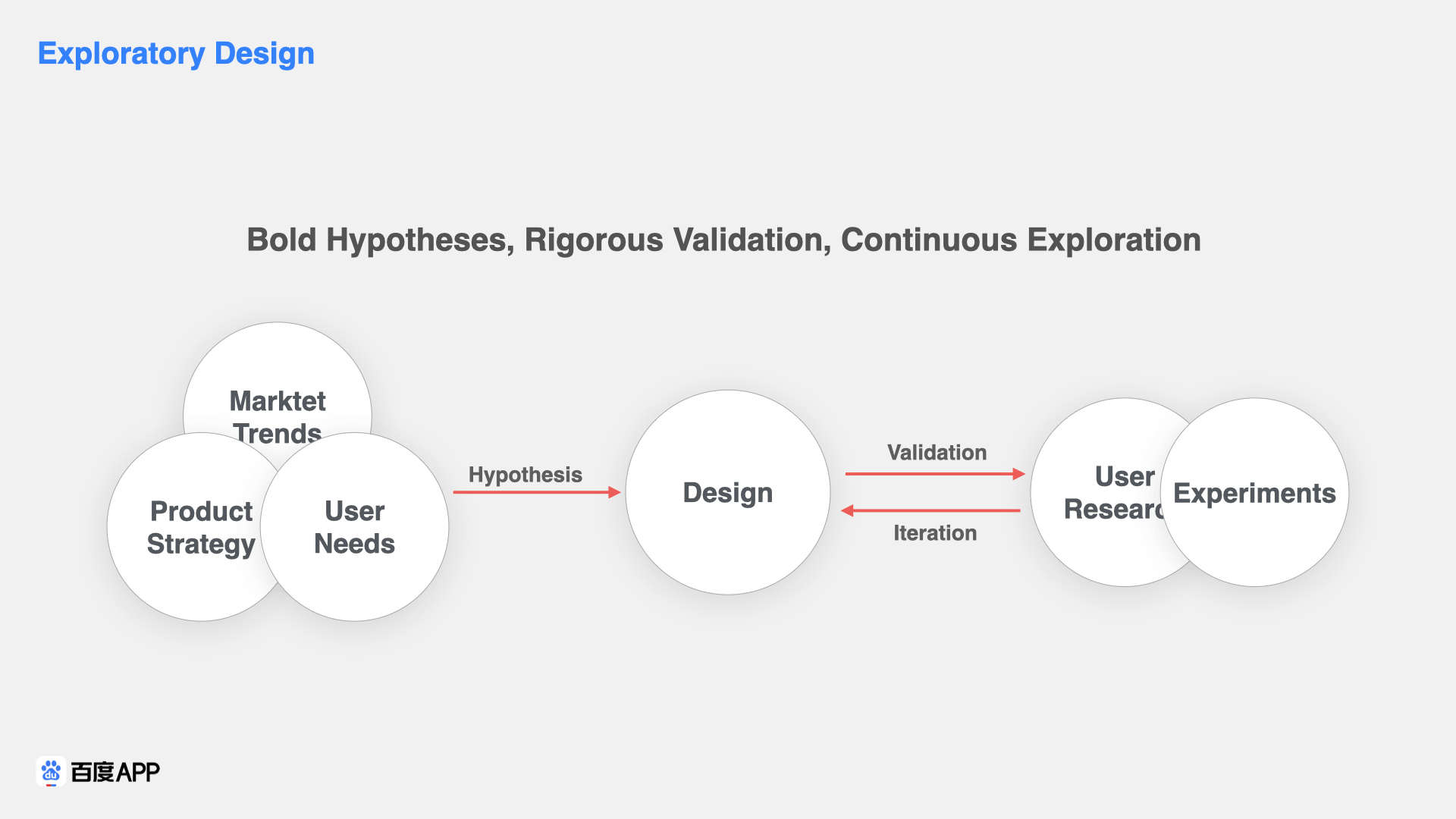
Mature products need to do more than improve existing experiences. As markets, technology, and user needs evolve, they must also expand their capabilities and create new ways to support business growth. As a Design Architect, I led exploratory work across several areas. Three areas best represent this work: rethinking the app's structure and navigation, designing and validating AI + search experiences at production scale, and designing for younger users.
App Structure and Navigation
Baidu App had to accommodate complex needs across search, the algorithmic feed, video, services, vertical channels, in-product campaigns, and monetization. Design needed to establish a clear, stable product structure for these needs while continuing to explore better interaction models as market trends and user behavior evolved. Where search appeared, how users moved between pages, and how different product areas gained entry points and visibility all shaped the core experience and overall usability.
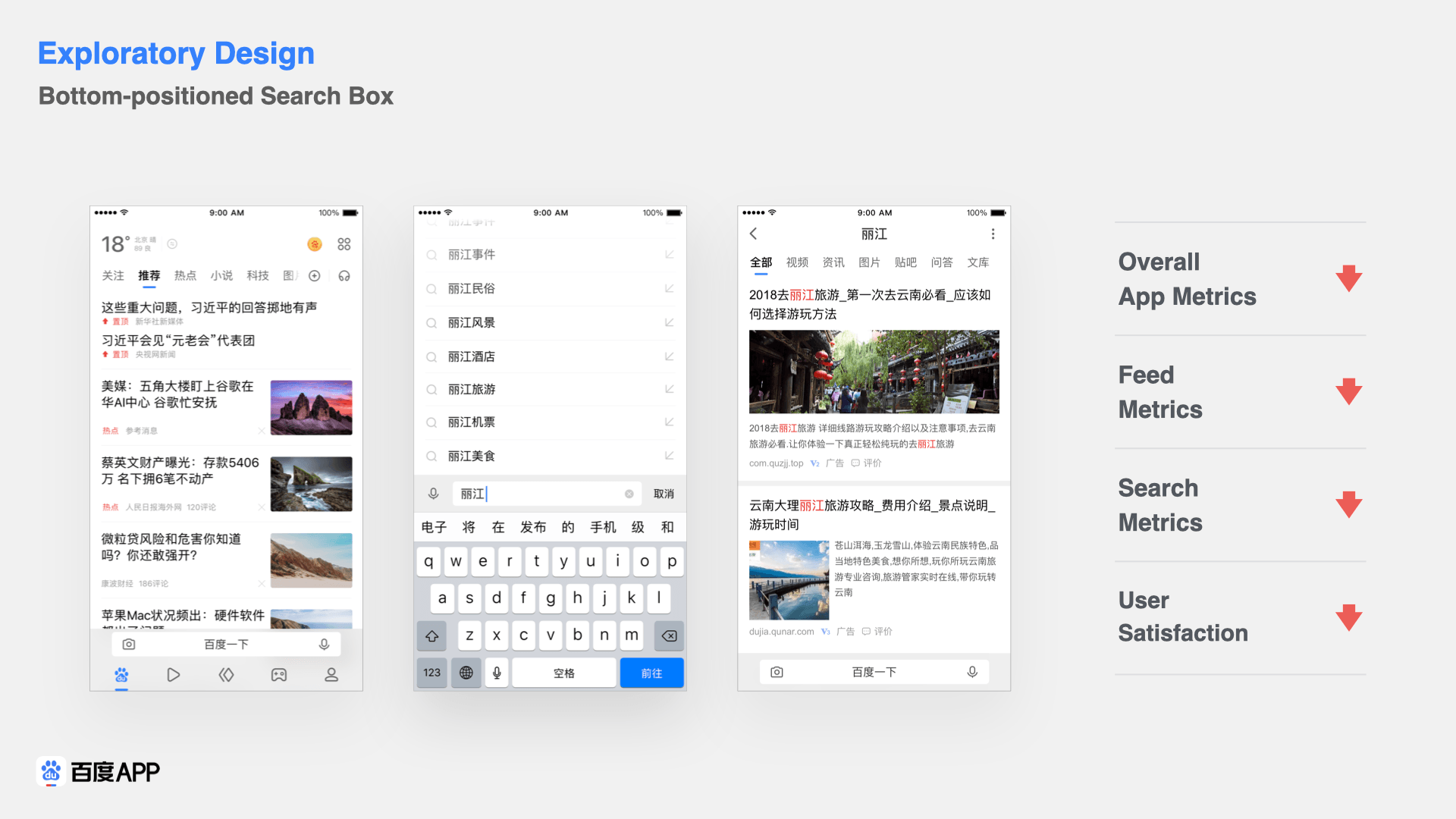
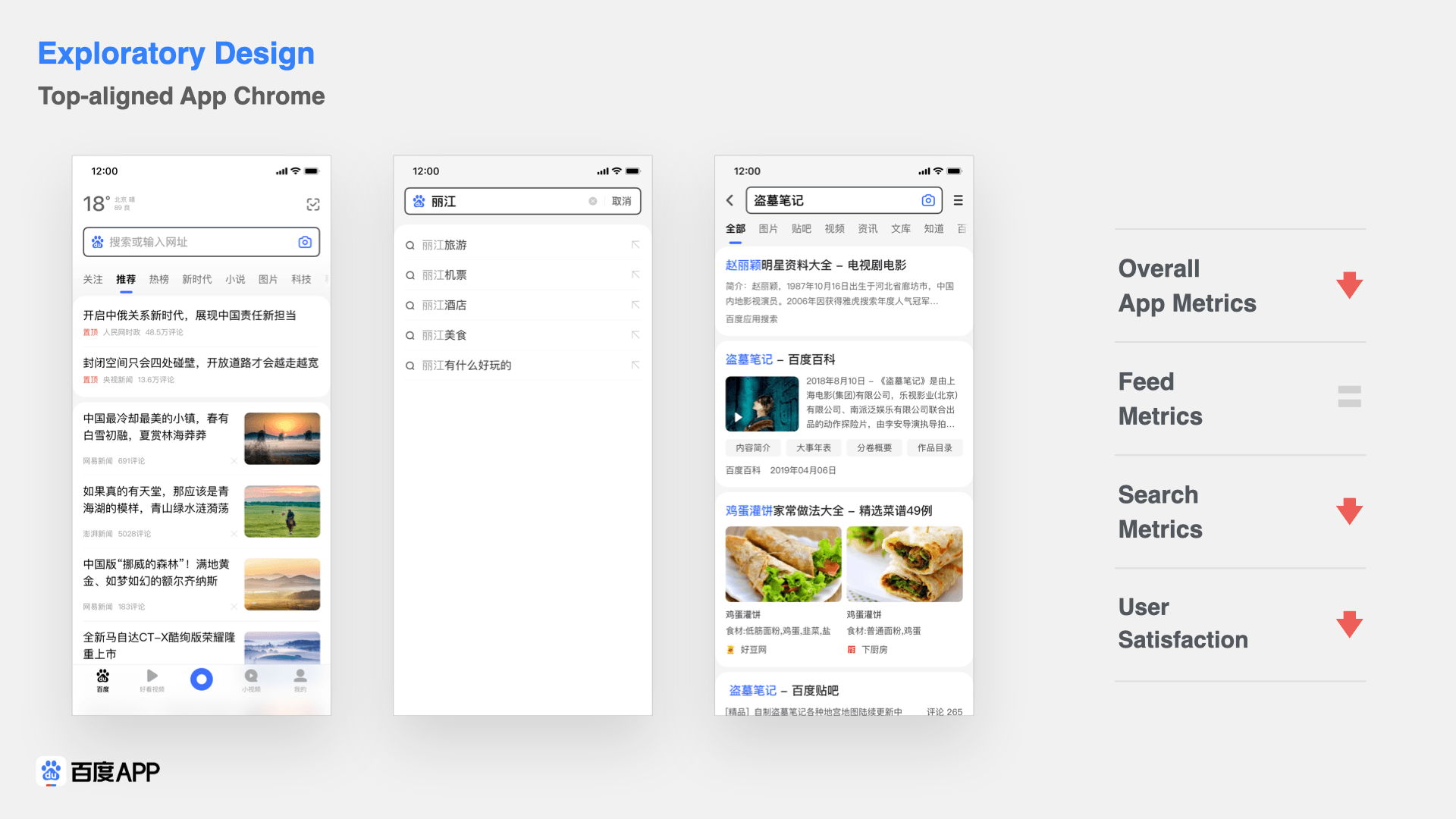
I led multiple explorations, including moving the search box to the bottom of the screen, reworking the app chrome by moving navigation from a browser-style bottom toolbar to the top, and using more flexible homepage containers to consolidate service entry points. These concepts tested whether new structures better matched mobile conventions and could support expanding product needs more flexibly without compromising search efficiency or established user expectations.
Every exploration of the app's structure went through multiple design variants, limited-traffic experiments, reversal tests, and data analysis. Few reached a full rollout. My rough estimate is that for every 100 concepts we designed, about 30 reached live experiments and 10 rolled out broadly. The work remained valuable even when a concept did not ship. These explorations helped the team understand user behavior and product constraints, rule out weak directions, and build a reusable base of design judgment and tested options for future iterations.
Designing AI + Search Experiences
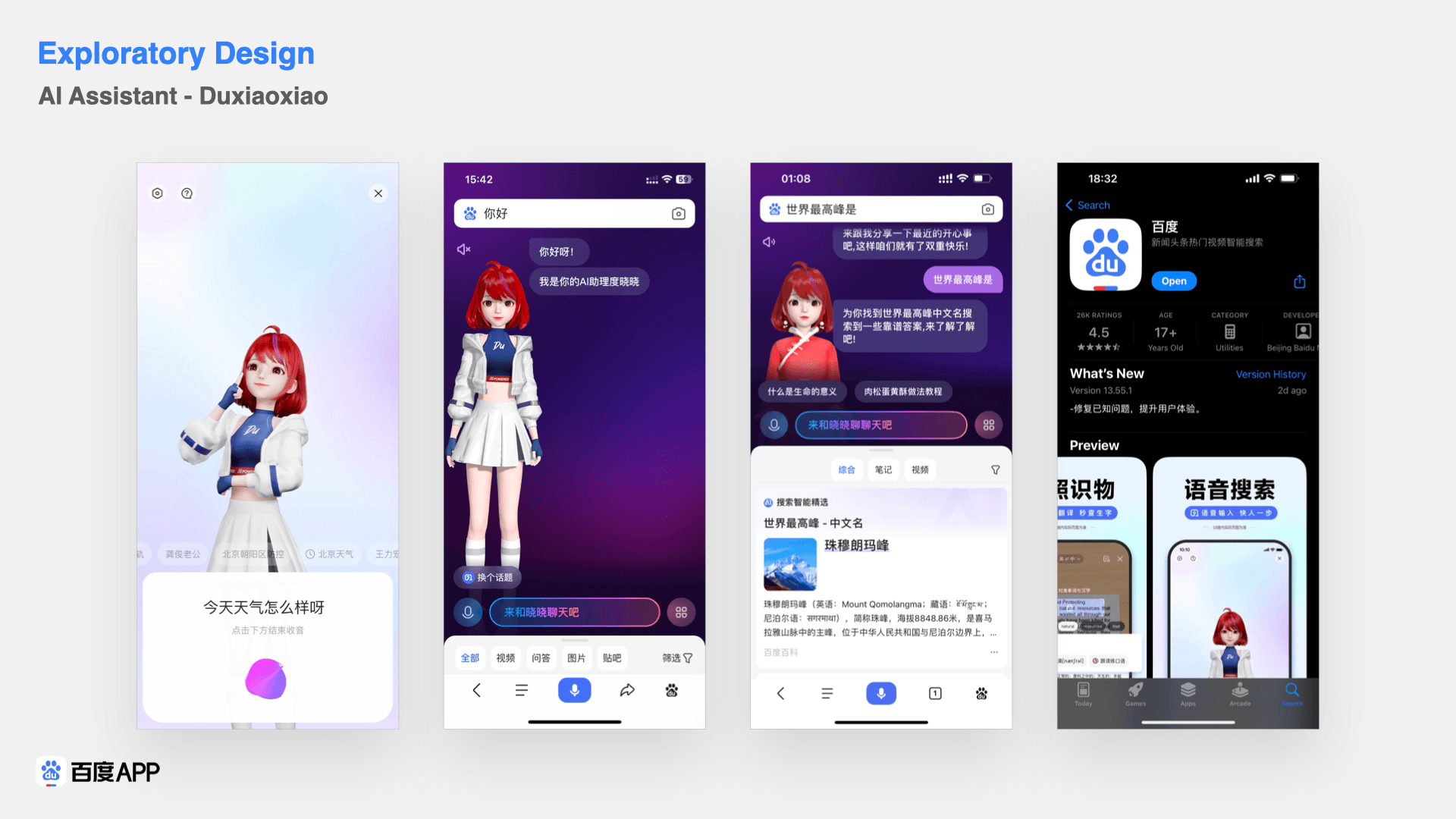
Baidu has invested in AI for years, and search is a natural product surface for applying it. In 2020, I began leading the team that built Duxiaoxiao, an AI virtual human assistant, and integrated it into Baidu App's voice-search journey. We preserved the efficiency of traditional search while adding conversation, facial expressions, body motion, and emotionally expressive responses. Duxiaoxiao reached tens of millions of users and accumulated billions of conversations in Baidu App, providing production-scale evidence of the value that human-like AI interaction could add to search. For the full product story, see AI Assistant - Duxiaoxiao.
In 2023, as large language models advanced rapidly, we applied insights from our earlier AI assistant work to search and completed the first version of Baidu Search AI Companion. The product had not launched by the time I left Baidu, but most of the design work was complete. This work gave me a clearer view of the limitations of traditional search and prompted me to think more deeply about how AI could reshape the way people engage with information, as well as the relationship between people and AI.
The key product decision was to treat the AI Companion as an extension of search rather than a replacement: preserve traditional search efficiency while adding a more human-like way to engage with information.
Designing for Younger Users
As a Design Architect, I led several cross-cutting research initiatives, including one focused on making Baidu App more relevant to younger users. The proportion of younger users in Baidu App's audience consistently trailed the market average and key competitors, which likely contributed to lower time spent and content engagement. I organized and led design experts from multiple teams to study younger users across content interests, community relationships, learning and career tools, self-expression, and visual taste. We synthesized the findings into five core issues: insufficient content for younger audiences, a weak sense of community, low awareness of the value of learning and career tools, limited personalization, and a UI aesthetic that felt too restrained. We then proposed product directions for each area.
These insights informed prioritization for several initiatives, including a Baidu App visual refresh and member-exclusive themes. We also proposed connecting Baidu Tieba, a Reddit-style forum community, more closely with Baidu App so interest-based communities and their content could make the product more relevant to younger users. In 2025, Tieba became a prominent entry in Baidu App's bottom navigation and was later integrated into the algorithmic feed. This development closely matched our earlier product judgment and recommendations, providing longer-term evidence of the research's value.
This type of research brought scattered user signals, competitive shifts, and business questions together into clear product insights and recommendations that informed organizational decisions and project prioritization. It also reinforced for me that strong exploratory design requires an understanding of changing user needs, the competitive landscape, business capabilities, and organizational resources. That broader view is what allows insights about emerging trends to translate into real product impact.
3. Building Platform Capabilities: Sustaining Innovation and Collaboration
Baidu App needed to keep creating new product and monetization capabilities while making them reliable across dozens of product teams. Alongside shipping individual innovations, I identified recurring needs across product lines and turned proven approaches into reusable platform capabilities. Representative efforts included homepage campaign and monetization capabilities, dark mode across Baidu's mobile products, and the Baidu App motion design system.
Homepage Campaigns and Monetization: From New Formats to Shared Standards
In China's internet market, in-product campaigns built around holidays and trending events are an important way to increase user engagement, expand visibility, and generate revenue. As the market matured, the Baidu App homepage remained a core distribution surface for search and content. It also needed to drive engagement through campaigns and turn its scale into revenue. Every campaign and commercial placement had to increase value without compromising the core experience.
Beginning in 2018, I led the team in creating and launching more than 10 capabilities for homepage campaigns and monetization across different campaign scales, engagement goals, and commercial use cases. These capabilities allowed major events, user engagement programs, and brand advertising to appear on the homepage in flexible formats that felt integrated with the product experience. They supported homepage advertising and brand programs for major clients, contributing to nine-figure annual revenue in RMB. In 2019, Baidu partnered with China Central Television and served as the online interactive platform for the CCTV Spring Festival Gala, China's most prominent annual Chinese New Year television event. These homepage capabilities enabled hundreds of millions of users to participate in digital cash-gift giveaways known as red envelopes and handled 20.8 billion interactions.
As these capabilities expanded, I established design governance for homepage campaigns through a centralized standards hub. The hub documented placement rules, ways to prevent conflicting placements, implementation templates, previous examples, and design guidance so different product teams could collaborate and deliver efficiently under shared rules. More importantly, I drove alignment among VPs on a set of core rules for homepage campaigns and monetization, including limiting the homepage to one featured campaign or ad at a time. These rules set clear boundaries for commercial requests and created a durable, enforceable balance between growth and user experience.
Dark Mode Across Baidu's Mobile Products
In 2019, dark mode was emerging as an important mobile product trend. As Baidu's largest and most complex mobile product, Baidu App needed to lead the effort and establish a unified approach. I led the development of design rules for Baidu's mobile products and coordinated implementation across product lines.
I first clarified how dark mode differed from traditional night mode, then conducted systematic research into use cases, low-light environments, visual perception, OLED black smearing, color contrast, and readability. To reduce black smearing on OLED displays at low brightness, we avoided pure black backgrounds and increased the brightness of lower-emphasis text. We also calibrated the hierarchy among text, icons, and backgrounds against accessibility contrast requirements to maintain readability across environments. Based on this work, I defined shared dark mode principles, color rules, and implementation standards for Baidu's mobile products, established an online collaboration hub, and partnered with engineering to define a shared theming architecture across technology stacks.
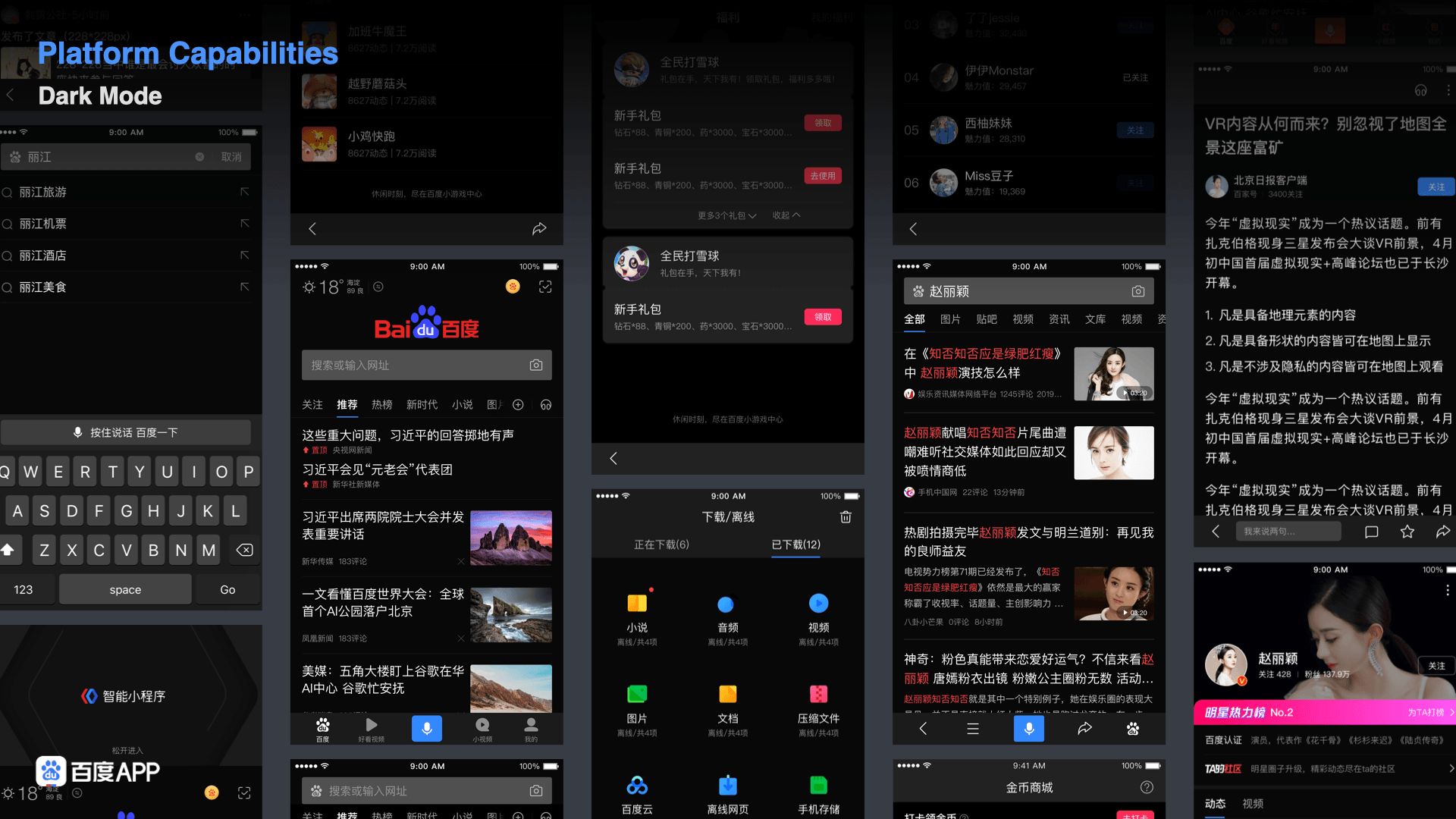
At the time, design tools such as Sketch and Figma did not support color variables. To reduce implementation effort across dozens of design teams, I partnered with engineering to develop a Sketch plugin with color-variable support. It could convert designs to dark mode or night mode in one step, substantially reducing implementation and handoff effort. With shared standards, tooling, and collaboration mechanisms in place, Baidu App and other Baidu mobile products became early adopters of dark mode in the market. This allowed the company to respond quickly to the industry trend while making its products more appealing through a more personalized visual experience.
Baidu App Motion Design System
As mobile device performance improved, motion became an important expressive layer in mobile interfaces. In product interactions, motion helps users understand state changes, spatial hierarchy, and the results of their actions. In campaigns, it makes experiences and brand expression more compelling and immersive.
I led the team in establishing foundational motion guidelines for Baidu App, defining shared principles and parameters for button feedback, page transitions, and component states. The guidelines were only the foundation. The larger goal was to give designers the ability to design, validate, and hand off complex motion from end to end. I developed a high-fidelity prototyping course that organized prototyping methods by use case and complexity, with reusable templates for triggers, property mappings, transitions, and parameter specifications. This helped designers communicate motion behavior to engineers more precisely. I also became a Baidu-authorized internal instructor. The course was added to the official design learning path at Baidu's internal Technology Academy and recommended to designers across the company.
At the implementation level, basic UI property transitions could be built in code, but complex motion was costly to hand off and reproduce faithfully in production. We first introduced Lottie, creating an end-to-end workflow for bringing 2D and vector motion from design into production. For more complex motion, we worked with engineering to develop an in-house video format with alpha-channel support called AFX, along with a conversion tool for designers. AFX balanced file size and runtime performance while supporting cinematic lighting and visual effects with transparent backgrounds. Baidu App ultimately established a complete motion design and implementation system spanning basic interface feedback, vector motion, and cinematic campaign visuals. Designers built high-fidelity prototyping and motion design skills through the course, then used Lottie and AFX to connect motion creation, asset handoff, and production implementation.
The projects I led showed that platform-level design work needs to go beyond standards and consistency. It also needs to connect product and monetization innovation, design principles, engineering mechanisms, organizational coordination, and productivity tools. Bringing these elements together allows teams to keep creating new value while giving collaboration and experience quality a reliable foundation within complex products.
Insights and Reflections
Over my decade on Baidu App, I worked at the scale of hundreds of millions of users, a complex product ecosystem, and a large organization. My scope expanded from specific experience design to business growth, cross-team collaboration, platform capabilities, and product direction. Along the way, I learned to find a sustainable balance among user value, business goals, technical constraints, and the needs of a complex organization. I grew from a designer responsible for an individual product area into a Design Architect working at platform scale. A few lessons stand out from that experience:
Innovating in a Mature Product Requires Flexibility and Persistence
Innovation in a mature product must work within the constraints of user habits, business priorities, technology costs, and organizational dependencies. Change rarely happens all at once. Years of homepage evolution taught me that a long-term direction needs to be broken into low-risk, testable steps, with a clear decision at each stage about what must hold and what can bend. This is how a team can keep moving toward a long-term goal within real-world constraints.
Data Cannot Replace Judgment, but It Can Build Consensus
Data may be objective, but metric definitions, measurement scope, and interpretation can all skew the conclusions. Data can help designers identify problems, test hypotheses, calibrate solutions, and give teams a shared evidence base. It cannot determine product direction on its own. That still requires judgment across user needs, market changes, business strategy, and design insight, followed by continuous testing against the data.
Designers Grow by Broadening Their Capabilities
The breadth of a designer's capabilities shapes the scale of problems they can understand and solve. Focusing only on the interface often limits the work to local improvements. Understanding the business, technology, data, and organizational context makes it possible to see the full problem and connect product direction with implementation and validation. Broadening that range does not mean replacing other functions. It means establishing a shared language, bringing different expertise together, and taking fuller responsibility for the outcome.
Beyond Solving Problems: Anticipating and Shaping Change
Finding and solving real problems is an essential design skill. To contribute at a higher level, designers also need to understand shifts in user behavior, technology, and the market, form an evidence-based view of what may come next, and translate that view into a testable path that can help shape business direction. That was the case with the Baidu App homepage. My early judgment about the relationship between search and the algorithmic feed became a product direction that guided homepage evolution for years and continued to support the product's growth.
Looking back on these ten years, I am grateful to Baidu for the opportunities to learn and grow, and to everyone who worked alongside me.

