
Behind Duxiaoxiao
Hands-on lessons from pre-LLM AI assistant design.
Who Is Duxiaoxiao?
Duxiaoxiao is China's first interactive AI virtual human assistant. Launched in 2020, it was Baidu's exploration of search innovation and the future of human-computer interaction. Through the standalone Duxiaoxiao App and Baidu App, Baidu's flagship mobile search and information app, she provided a face-to-face-style experience for intelligent search, question answering, companionship, and character progression. She also served as Baidu's virtual idol, a character-based brand and entertainment asset used in brand campaigns and cross-brand marketing partnerships.
Here, I focus on the design decisions, tradeoffs, and working methods behind Duxiaoxiao. For a broader overview of the product itself, see AI Assistant - Duxiaoxiao.
Why the Design Work Was Challenging
Navigating an Uncharted Product Space
Duxiaoxiao was a 0-to-1 effort to explore the largely uncharted space of AI virtual human assistants. The design process required us to continually push boundaries, test ideas, validate assumptions, and recalibrate the path forward. Designers had to proactively understand the relevant technology, market, and production ecosystem, then keep making decisions with limited precedent.
Bridging Design, Technology, and Production
The work spanned consumer AI products, multimodal interaction, traditional interface design, and 3D character design. It also required close collaboration with a broad group of partners, including AI engineers, data scientists, and marketing teams. The design team needed both multidisciplinary design capabilities and the ability to work effectively across functions.
Balancing Experience, Feasibility, and Cost
Bringing all of these disciplines together required balancing experience quality, technical feasibility, resources, and cost. Every tradeoff had to support the same experience goal: an AI virtual human that felt natural and emotionally expressive.
How the Work Evolved Across Two Phases
The Duxiaoxiao project ran for three years, from early 2020 to early 2023. In retrospect, the work evolved through two distinct phases:
Phase One: Over nearly one year, we used the standalone Duxiaoxiao App to define a mobile interaction model for an AI virtual human assistant and test whether users would accept this new type of product. As the Design Lead, I focused on defining the interaction framework, making key design and technical tradeoffs, and building a multidisciplinary design team.
Phase Two: Over the following two years, we integrated Duxiaoxiao into existing user journeys in Baidu App, a product with roughly 200 million daily active users, to validate its value at production scale. We also improved the team's production capabilities so Duxiaoxiao could support Baidu's younger-facing brand presence and generate revenue through cross-brand partnerships during the metaverse boom in China. My focus shifted toward setting team goals, guiding experience improvements, streamlining workflows, connecting asset pipelines, and identifying new user touchpoints.
The following sections cover each phase in detail.
Phase One - Definition and Tradeoffs
Phase One lasted nearly a year. The core challenge was turning the broad vision of an AI virtual human assistant into a product that could be built and tested. During this phase, I made key product and technology tradeoffs, worked directly on the hardest design problems, built a multidisciplinary team, and gradually established the design system and working methods.
1. Define the Goal and Choose a Path
As the Design Lead, I was deeply involved in defining Duxiaoxiao's product goals and choosing the path forward.
Assess Technical Boundaries
We began by assessing the capabilities and limitations of the technology available at the time. This assessment directly shaped our business expectations and defined the scope of the product and design:
Natural language processing: In 2020, LLMs were not yet mature. Mainstream BERT-based systems performed well with structured knowledge, but were weak at multi-turn context and generalization, making natural conversation and ambiguous requests difficult. This meant factual and knowledge-based requests would be the product's strength. To make conversations feel more natural, we would need to compensate with extensive hand-authored templates, intent-slot structures, and dialogue scripts.
Speech technology: Speech synthesis was already reasonably natural and could generalize well. Text-to-speech was not fully real time, but latency had become relatively low. Full-duplex voice interaction was technically possible, though not yet reliable enough for the core experience. As a result, the primary interaction still needed to be turn-based, with users tapping to speak, rather than an always-on, continuous conversation.
Virtual human technology: The field was still at an early stage, with two main approaches: image generation and real-time 3D graphics. Image-based approaches could produce more photorealistic visuals, but real-time animation was largely limited to lip movement and facial expressions, which often made the character feel static. They also depended on compute-intensive cloud rendering, making costs difficult to control for a personalized AI assistant at scale. Real-time 3D graphics, by contrast, could build on established practices from games and animation. Facial and body animation technologies were more mature, rendering could run on the device at lower cost, and reliable solutions already existed for real-time lip sync and facial animation. Although full photorealism was harder to achieve, the character could feel more natural and expressive overall. For these reasons, real-time 3D was the better fit for an AI assistant at the time.
Define Product Positioning and Success Metrics
These constraints informed the product positioning and success metrics:
Product positioning: The core experience would focus on knowledge and information access, building on Baidu's strengths in search and knowledge services while staying within the capabilities of conversational AI at the time. On top of that foundation, conversation, companionship, character progression, and selected children's learning use cases would help build an emotional connection and explore what a virtual human could offer beyond a traditional AI assistant.
Success metrics: Total user interactions served as the primary metric. Accumulating a meaningful volume of real interactions gave us a stronger evidence base for evaluating the product's value and improving the experience. We later added the number of conversational turns within chat-oriented sessions to understand whether users wanted to continue talking and whether the virtual human added value to natural conversation and companionship.
Choose the Character Strategy
We then considered two character strategies: user-created characters and a single defined character.
User-created characters: Customization could better match individual preferences and strengthen a sense of personal ownership. However, it would require a large, standardized library of character models, clothing, facial expressions, and animations. Spreading limited resources across that production scope would make it difficult to maintain both quality and cost efficiency.
A single defined character: Concentrating on one character allowed us to invest more deeply in her visual design and personality. A consistent character could also express a clearer identity, build recognition with users, and develop into a long-term brand asset. This better supported our immediate goal of validating the AI virtual human assistant concept. Character customization could come later, once the core product had been sufficiently validated.
Choose the Validation Path
We chose to begin with the standalone Duxiaoxiao App rather than integrating directly into Baidu App. An independent app was not constrained by an established product's existing user habits and journeys, release requirements, or cross-team dependencies. This gave us more flexibility to iterate and stay focused on the AI assistant experience itself. Once the key experience had been validated, we could integrate it into Baidu App and test its value with a much larger user base.
Before development began, we had aligned on the product positioning, capability boundaries, core product model, success metrics, and execution path. This gave the team a shared foundation for subsequent decisions, implementation, team building, and resource allocation.
2. Define the Character and Choose the Engine
Duxiaoxiao's visual design was the outward expression of her personality and directly shaped users' first impressions. The choice of visual style and rendering engine also affected interaction quality, runtime performance, and content production costs. As the Design Lead, I was deeply involved in defining the character and selecting the engine, and I led the execution of the character design. Based on market research and technical feasibility analysis, I presented our recommendation to a Baidu vice president and aligned on the visual direction and quality bar, establishing a foundation for the design and production work that followed.
Define the Character and Visual Direction
We defined the character and visual identity, which shaped both users' first impressions and whether they would remember her over time:
Character concept: An AI assistant needed to feel intelligent and reliable, but a character who seemed too perfect could also feel distant. We therefore created a backstory in which Duxiaoxiao began as a meteorite from outer space and was brought to life after Baidu engineers infused her with a knowledge base about humanity. She knew a great deal, but lacked real-world experience and remained deeply curious about human life. This explained both her knowledge and her limitations, while making her feel more approachable through a continuing journey of discovery and growth.
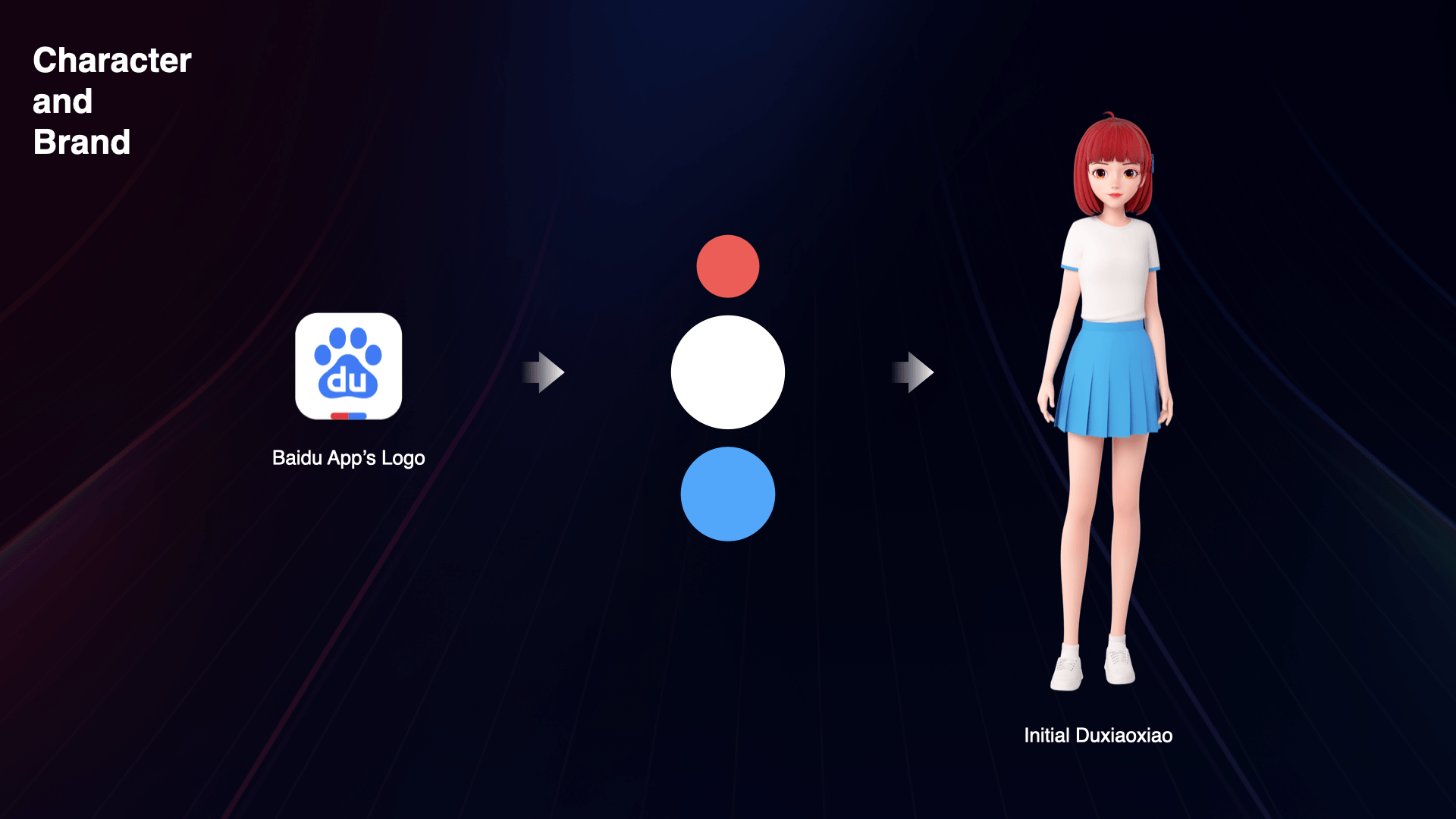
Character design: To reach a broad audience, the character needed to feel approachable, easy to understand, and distinctive without appealing only to a niche group. We chose a young female character with broadly accessible styling and incorporated Baidu's red, blue, and white brand colors through her red hair, white top, and blue skirt. Because the initial focus was the AI assistant experience, her base design remained simple and supported interchangeable outfits. We later upgraded the character when the virtual idol role became more important, which I cover in a later section.
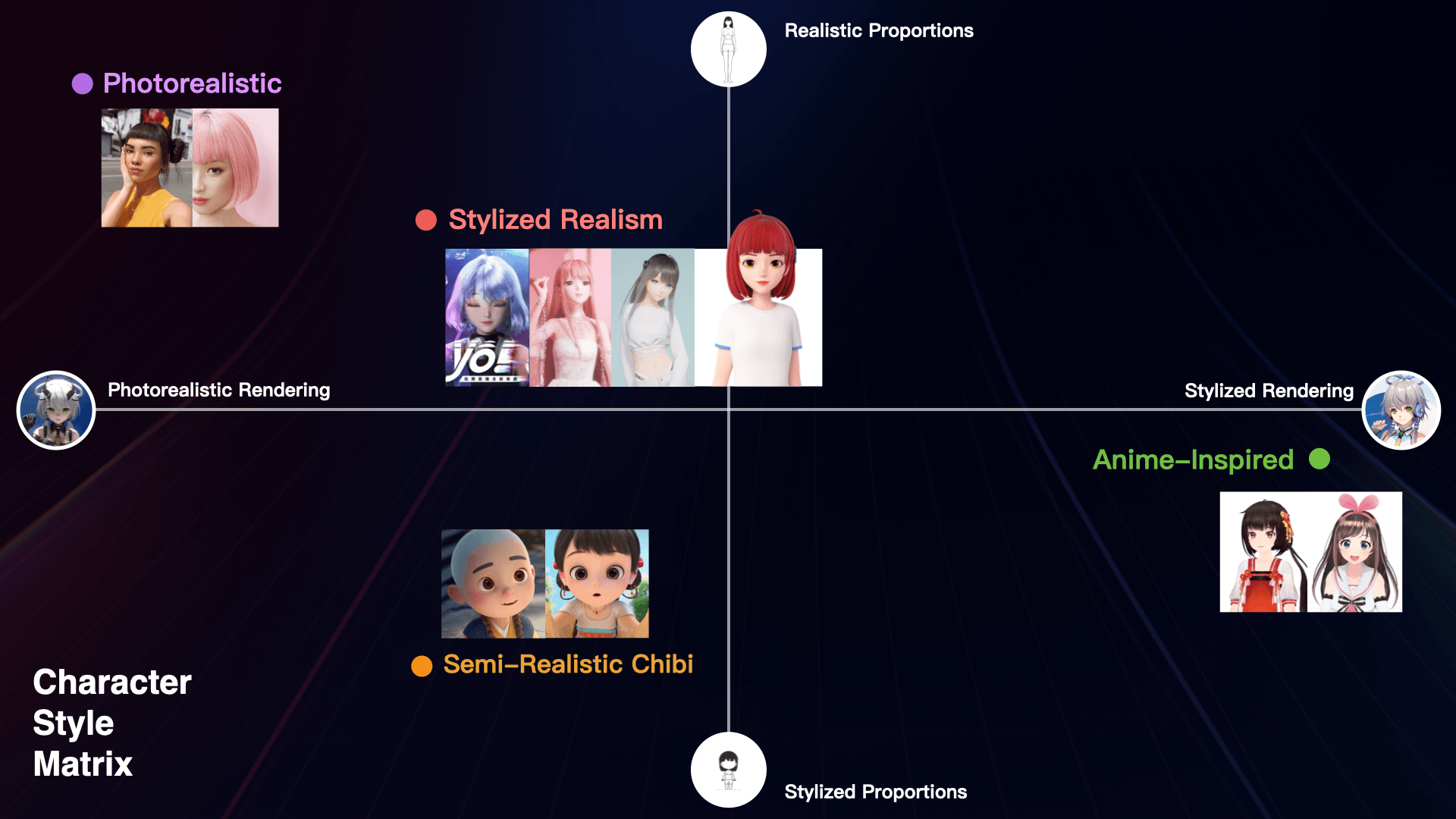
Rendering style: The rendering style affected not only visual appeal and audience acceptance, but also whether the character could run in real time on smartphones. Anime-inspired characters appealed to a more limited audience, while fully photorealistic characters risked the uncanny valley and required much greater model fidelity and rendering performance. We chose a stylized-realism approach that balanced broad appeal with emotional expressiveness while allowing the character to render smoothly on mobile devices.
Choose the Real-Time Rendering Engine
We evaluated the real-time rendering engine, which would determine the character's live performance, runtime efficiency, and integration with the native app interface. This involved another set of tradeoffs:
Three.js: Three.js is a lightweight, web-based 3D engine. It was easier to integrate with traditional UI and better suited to eventual integration into Baidu App, making it our first choice for quickly validating virtual human interaction. Compared with mature game engines, however, Three.js lacked a comprehensive visual editor and rendering pipeline. The team would need to build more capabilities itself, and the ceiling for visual fidelity was lower.
Unity: As a mature cross-platform game engine, Unity offered more complete authoring tools, rendering pipelines, and 3D content production capabilities. We explored a Unity prototype and tested it in the Duxiaoxiao App to determine whether real-time AI assistant interactions and 3D content production, including promotional videos and brand partnership content, could share one engine and production pipeline. However, Unity added significant app size, was harder to combine with a native mobile UI, and created additional performance and battery-consumption concerns. We ultimately decided against using Unity as a single engine for everything. Three.js powered real-time interaction in the mobile app, while traditional digital content creation (DCC) tools and Unreal Engine supported high-volume 3D content production. I cover that production workflow in more detail later.
3. Build the AI Virtual Human Assistant Design System
In the hands-on design work, I not only set direction for the team but also worked directly on the most important and difficult problems.
Design Vision and Principles
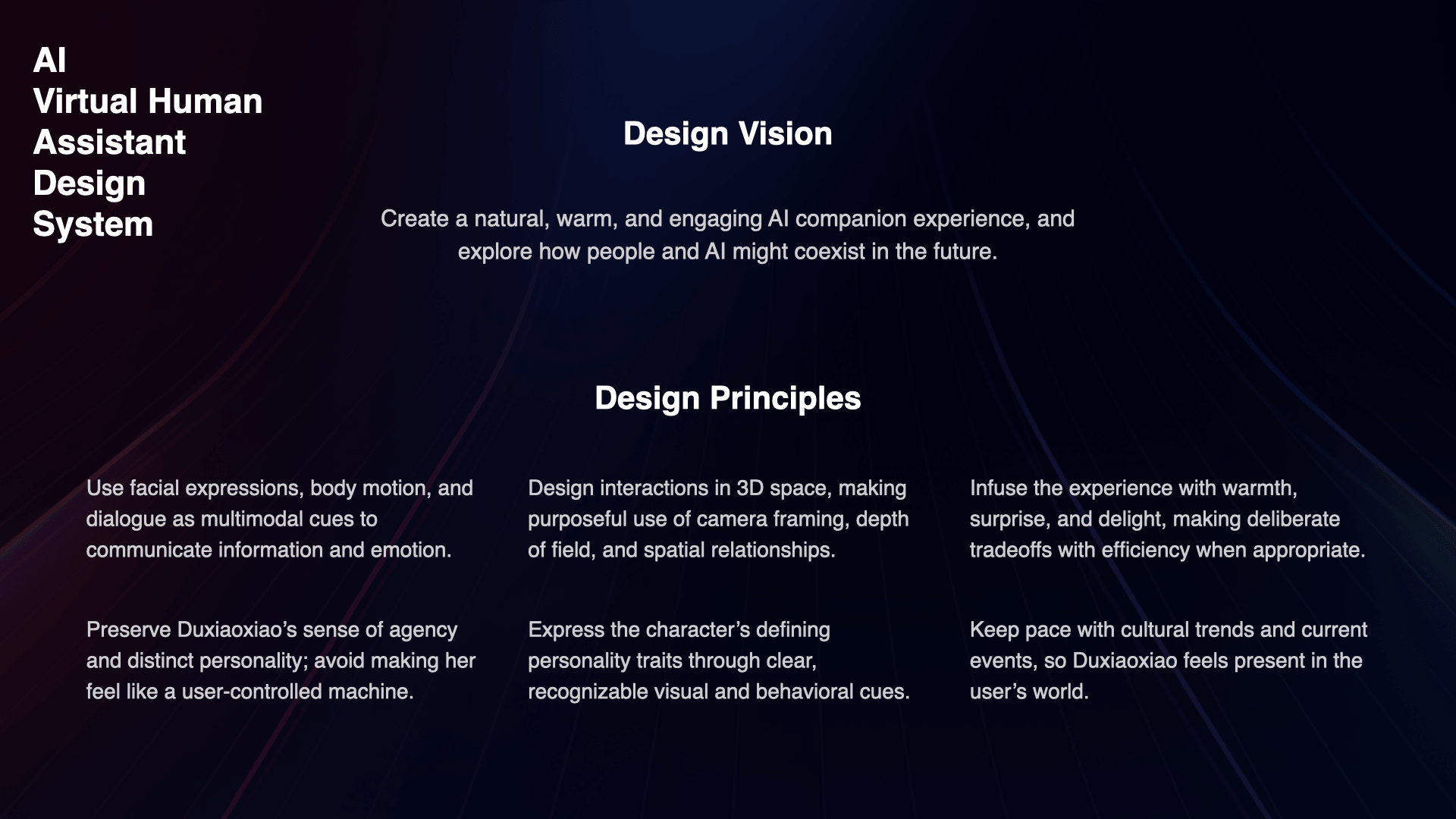
Through research and practice, I defined the design vision and principles for an AI virtual human assistant and aligned product and engineering teams around them. This created a shared understanding of the intended experience and gave the team clear criteria for evaluating later design decisions and tradeoffs.
Design Framework
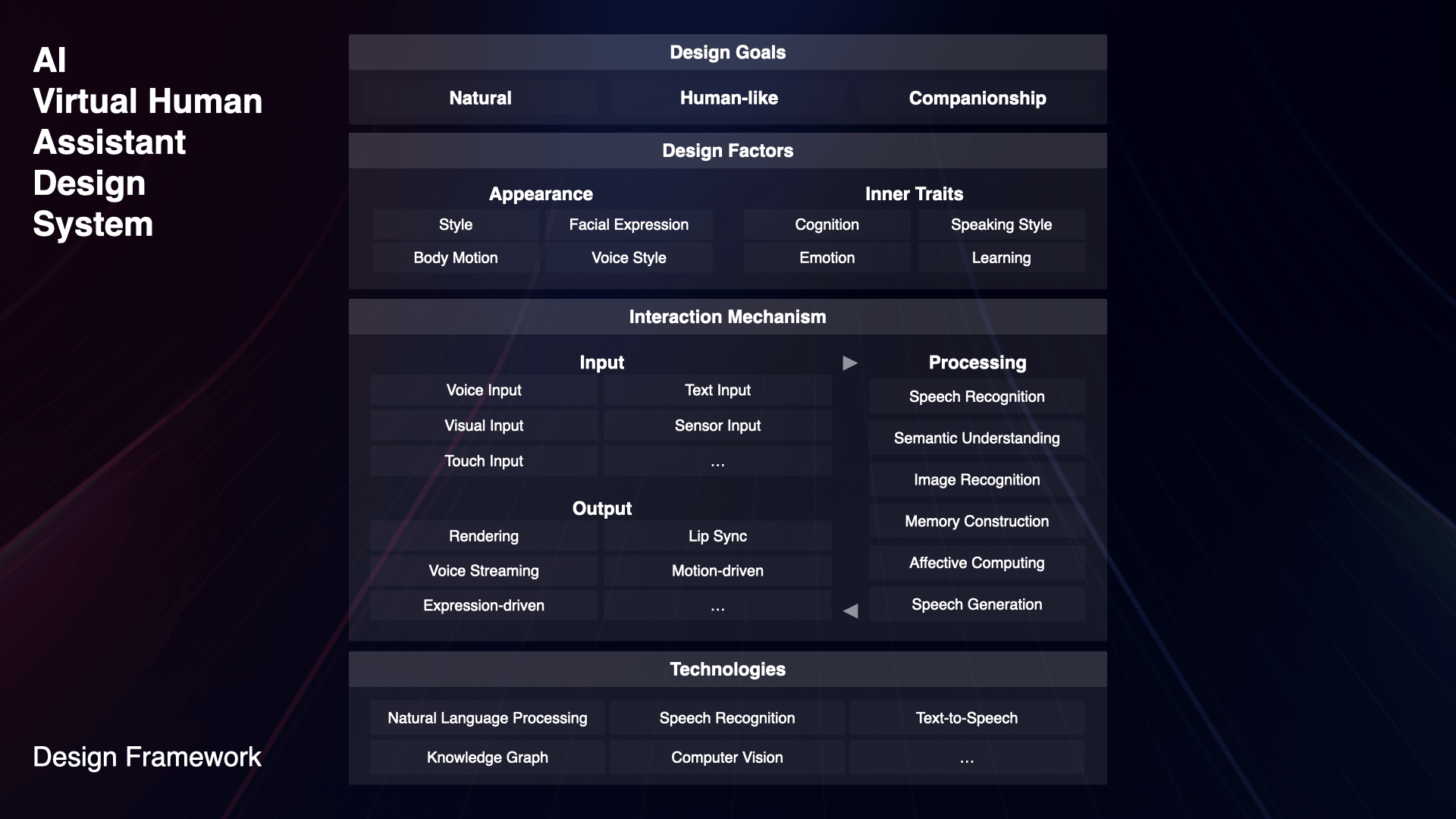
I organized the design goals, character attributes, interaction mechanisms, and underlying technologies into a design framework at the core of the design system. It helped the team understand how voice, facial expressions, body motion, lip sync, spatial presentation, and interface elements worked together, so designers could approach the experience holistically and collaborate across disciplines.
Mobile Interaction Model
I developed a mobile interaction model that could flexibly combine virtual human interaction with conventional mobile UI. It established a consistent foundation for presenting information, completing tasks, and expressing the character, and became the standard model for applying the experience across different mobile use cases.
Together, the design vision and principles, design framework, and mobile interaction model formed a complete AI virtual human assistant design system. It gave designers a stable structure and shared language for collaboration, established a reliable foundation for experience quality, and supported the product's continued evolution.
4. Build the Team and Working Methods
Build a Multidisciplinary Team
The complexity of the product required a design team that could cover product experience, visual design, character development, and 3D technology. Building that team was not simply a matter of hiring designers from different disciplines; those capabilities also had to be integrated around a shared experience goal.
Product design talent was more readily available, so I focused on whether designers were willing to explore an unfamiliar space, think systematically, and collaborate across disciplines. I established shared goals and a common design framework for the team, then guided UX/UI designers beyond conventional interface design to solve problems from the perspective of the complete multimodal experience.
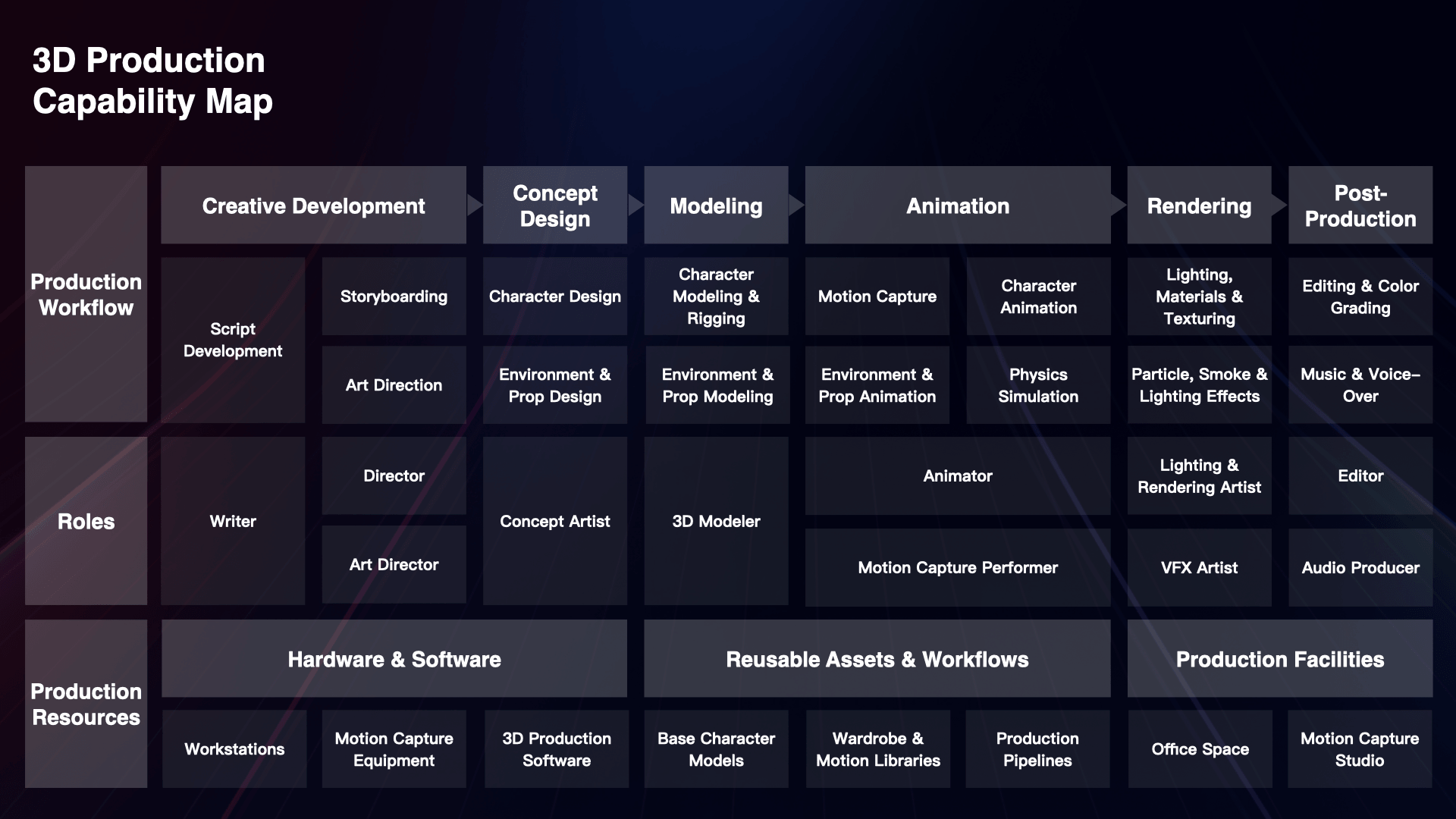
Building the right mix of 3D production capabilities was more difficult. The game, animation, and advertising industries had many 3D specialists, but their roles and career paths were highly specialized. Few had the breadth to consider an AI virtual human assistant as a complete experience, and fewer were interested in moving beyond their established disciplines. I first needed to understand the fundamentals of 3D design and production, map the roles, workflows, and resources required across the pipeline, bring together specialists from different fields, and gradually develop a more integrated team. I recruited designers from inside and outside Baidu who could cover visual development, character modeling and rigging, and lighting and rendering. This filled the immediate capability gaps while allowing us to develop multidisciplinary designers who could collaborate across the production pipeline.
Develop Director-Style Design and Prototyping
The team's working methods also needed to evolve with the product.
For product design, the multimodal nature of an AI virtual human assistant meant that the team could not focus on the interface alone. Dialogue, voice, emotion, facial expressions, body motion, and spatial relationships all had to be orchestrated into a coherent and natural character experience. I called this director-style design: designers worked like directors, using the character's dialogue and emotional intent to choreograph voice delivery, facial expressions, and body motion. These decisions were not limited to design specifications; they could be implemented through client-side scripts or matched and triggered by the dialogue system.
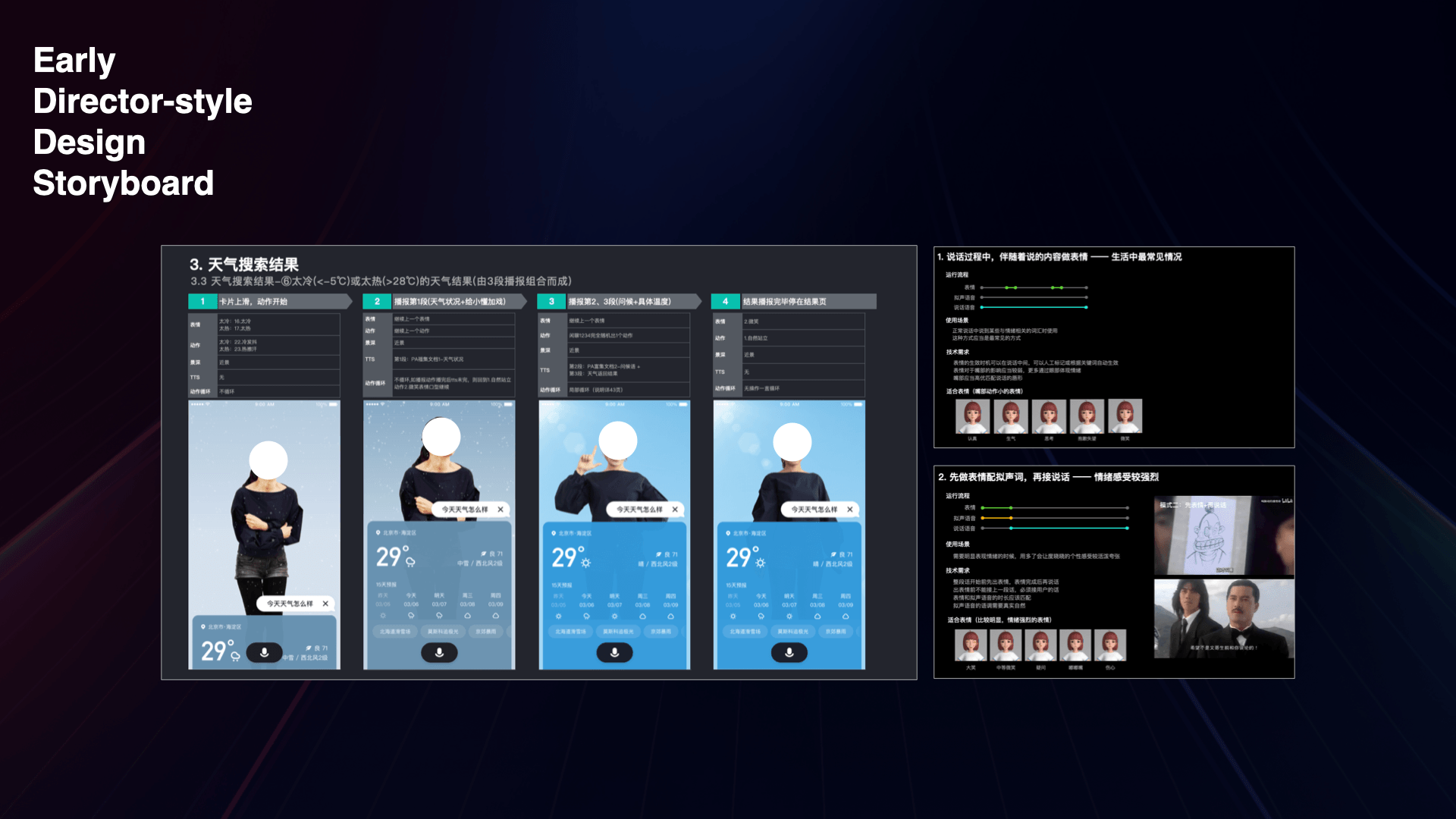
Once the Duxiaoxiao App had taken shape, I collaborated with engineering to build a separate mobile character performance prototyping tool for designers. Through JSON configurations, designers could preview and produce combinations of dialogue, body motion, facial expressions, and outfits directly on a smartphone, allowing them to validate whether their designs and choreography felt coherent and natural. Before the tool was ready, designers even used photos of their own performances to simulate character states. This helped the team validate the complete experience and determine which animations should later be produced through motion capture.
Adapt 3D Character Production for Mobile
The broader 3D industry already had mature methods for character production, from high-fidelity modeling, rigging, skinning, and hair production to mobile optimization techniques such as topology optimization, polygon reduction, texture baking, and asset compression. Our main challenge was establishing effective rendering practices in Three.js: balancing materials, lighting, visual quality, and runtime performance within limited device capabilities.
Scale 3D Content Production with Unreal Engine
Producing content at scale required a different set of tradeoffs. Most Duxiaoxiao content was created to keep the character active and visible through social media, brand campaigns, and partnership promotions. The cadence of new content mattered more than maximizing the fidelity of every individual asset. Traditional animation and game production workflows, which invest significant time in refining details, were too costly and slow for this need.
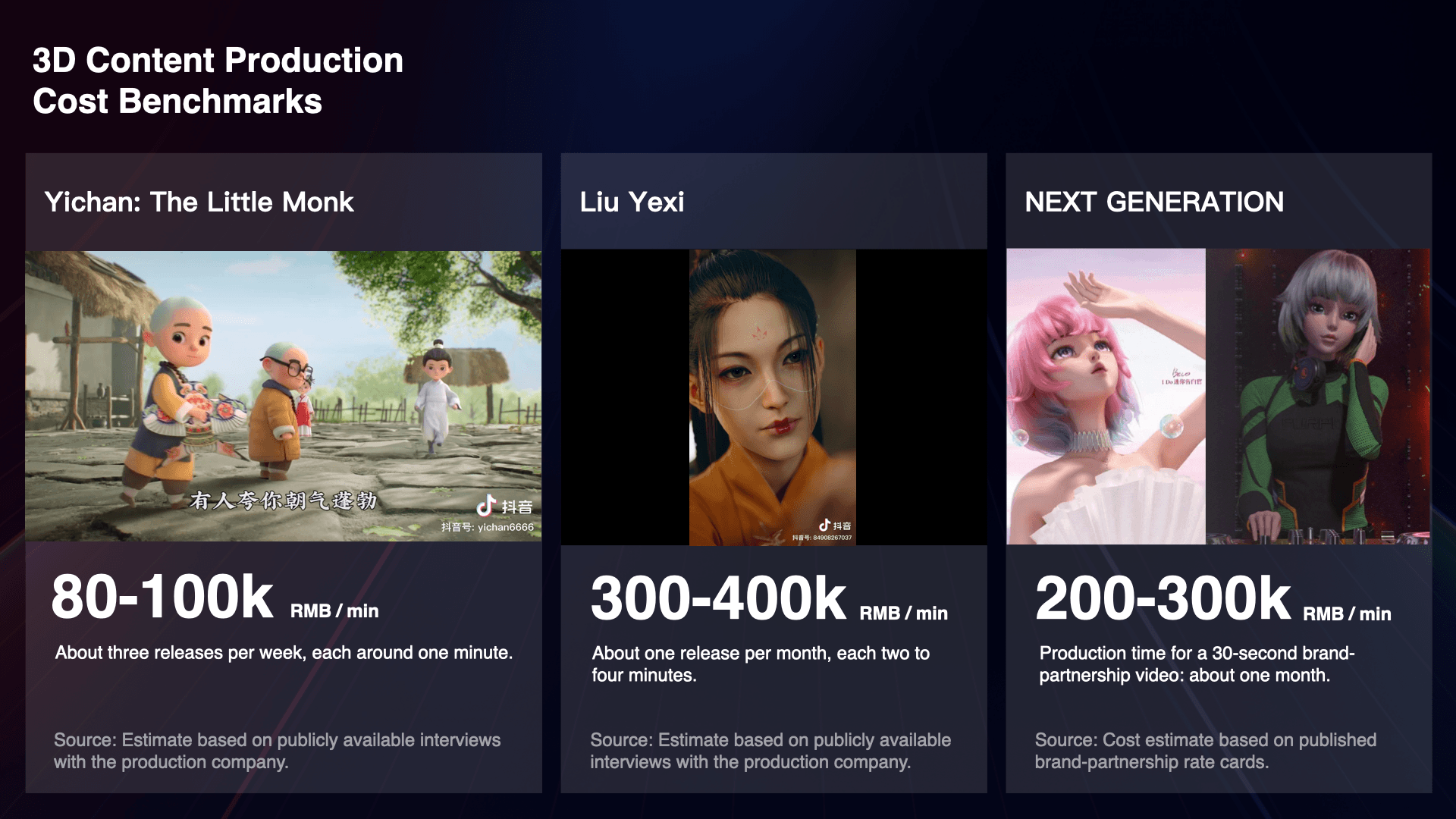
I therefore chose Unreal Engine as the hub for assembling characters, environments, animation, props, and lighting, and for producing high-volume content. This allowed the team to reuse a shared asset base and shorten production cycles through real-time rendering, establishing a foundation for continuous content production. We reserved traditional DCC tools and higher-fidelity craftsmanship for foundational assets and the most important content.
This completed the core work of Phase One. After nearly a year of exploration, the product direction, design system, team collaboration, and production workflows were all operating together. More importantly, within six months of launch, the Duxiaoxiao App reached hundreds of thousands of users and tens of thousands of daily active users. This provided early validation that users would accept virtual human interaction and laid the groundwork for integrating Duxiaoxiao into Baidu App and testing its value with a much larger audience.
Phase Two - Validation and Growth
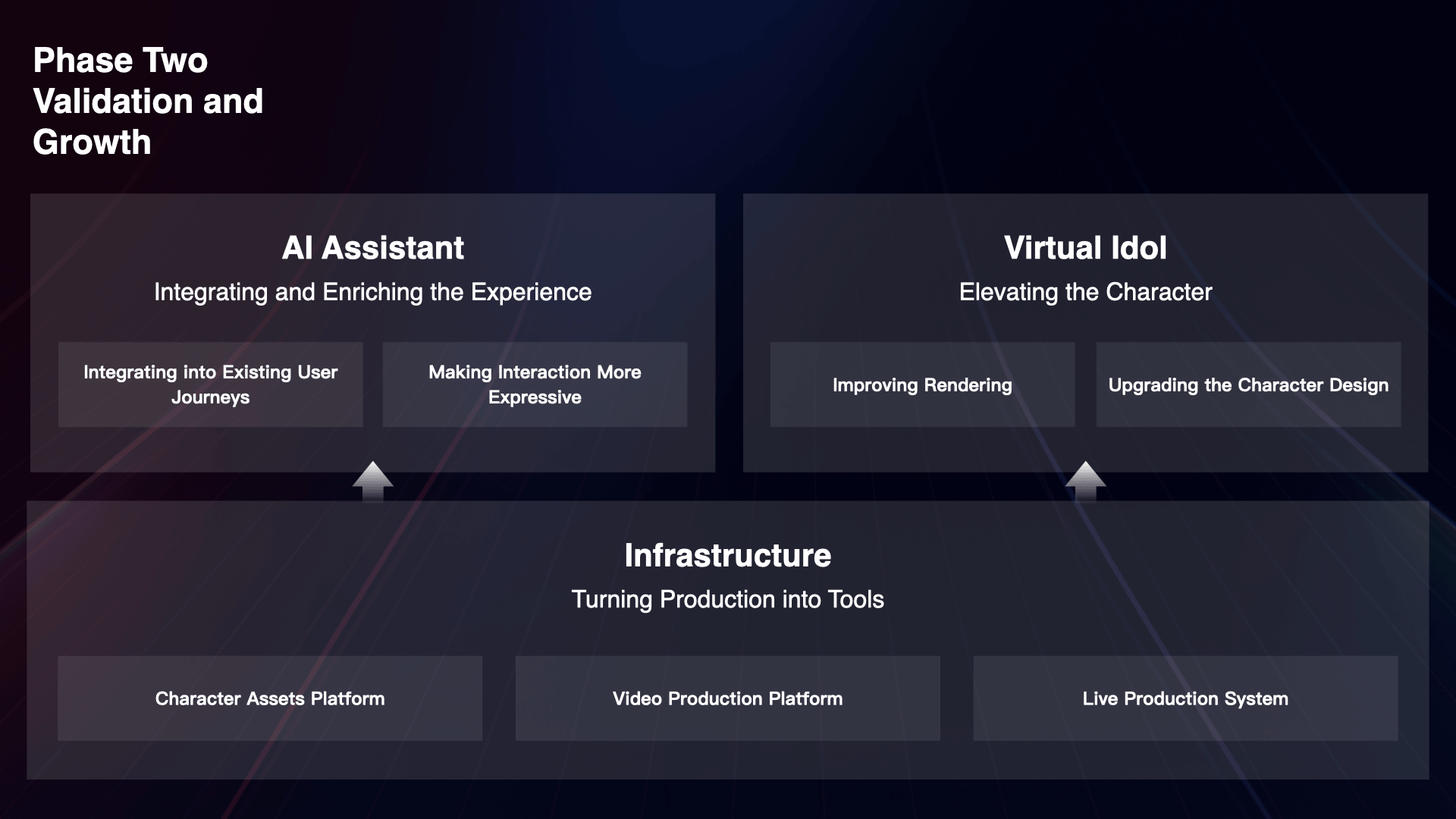
Phase One took the AI virtual human assistant from a 0-to-1 exploration to a relatively stable product model, design system, and production workflow. In Phase Two, the focus shifted to validating its value in real-world use at scale and driving growth through brand and commercial partnerships. My role also evolved from directly solving individual design challenges toward setting goals, guiding direction, and coordinating across teams. I established three workstreams for the design team: the AI assistant experience, the virtual idol, and production infrastructure. For each, I defined the objectives and approach, then continued to calibrate direction, coordinate resources, and guide the team in supporting the business.
1. AI Assistant: Integrating and Enriching the Experience
Integrating into Existing User Journeys
Bringing the AI virtual human assistant into Baidu App required finding the right places within existing user journeys where conversational and emotionally expressive interaction could add real value. The goal was not to force users to adopt a new interaction model simply to showcase the technology. The more important design question was which needs were genuinely suited to conversation, and how the virtual human could connect naturally with the product's existing capabilities.
Voice search was one of the strongest opportunities. Baidu App's existing voice search functioned primarily as voice input: after users spoke, their needs were still addressed through conventional text-based search results. Adding an AI virtual human assistant gave voice search conversational and emotionally expressive capabilities, allowing it to support chat and companionship as well as information retrieval. Given both the range of relevant user needs and the size of the existing audience, it was the best entry point for validating the value of a virtual human at production scale.
The interaction model developed in Phase One could already accommodate conventional search results, but it needed to be adapted to Baidu App's user journeys. In the standalone Duxiaoxiao App, users encountered the character immediately upon entering, so we minimized conversation history and gave more screen space to the virtual human, making each interaction feel closer to a face-to-face exchange. In Baidu App, reaching Duxiaoxiao required a longer journey, and users also needed to move between conversation and search results. We therefore reduced the character's screen presence and preserved each conversational turn, creating a more continuous and legible information experience.
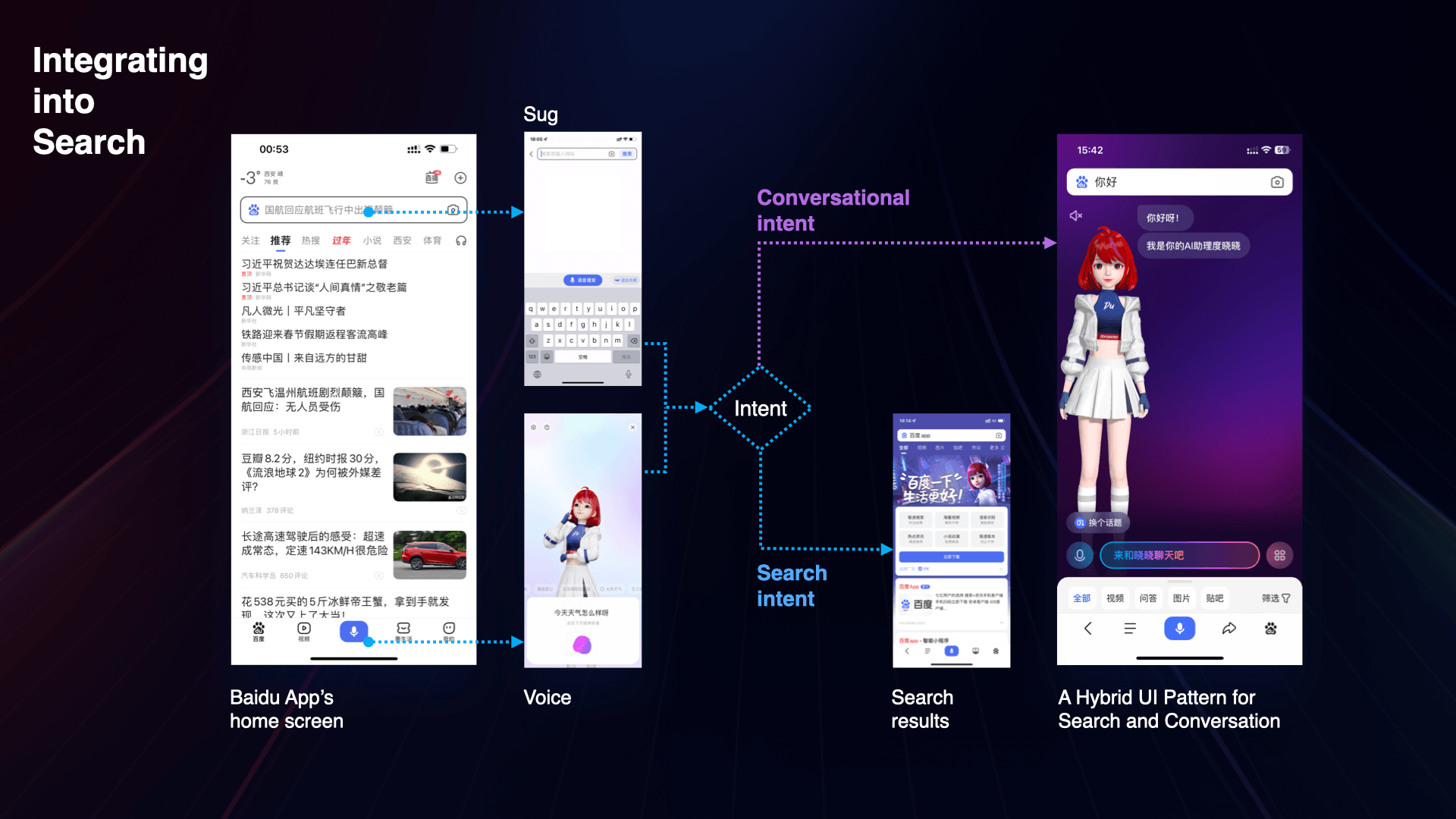
We continued to explore other use cases where the virtual human could offer distinctive value. Customer support was an obvious fit. Evolving a conventional support chatbot into a more approachable virtual human immediately improved user satisfaction.
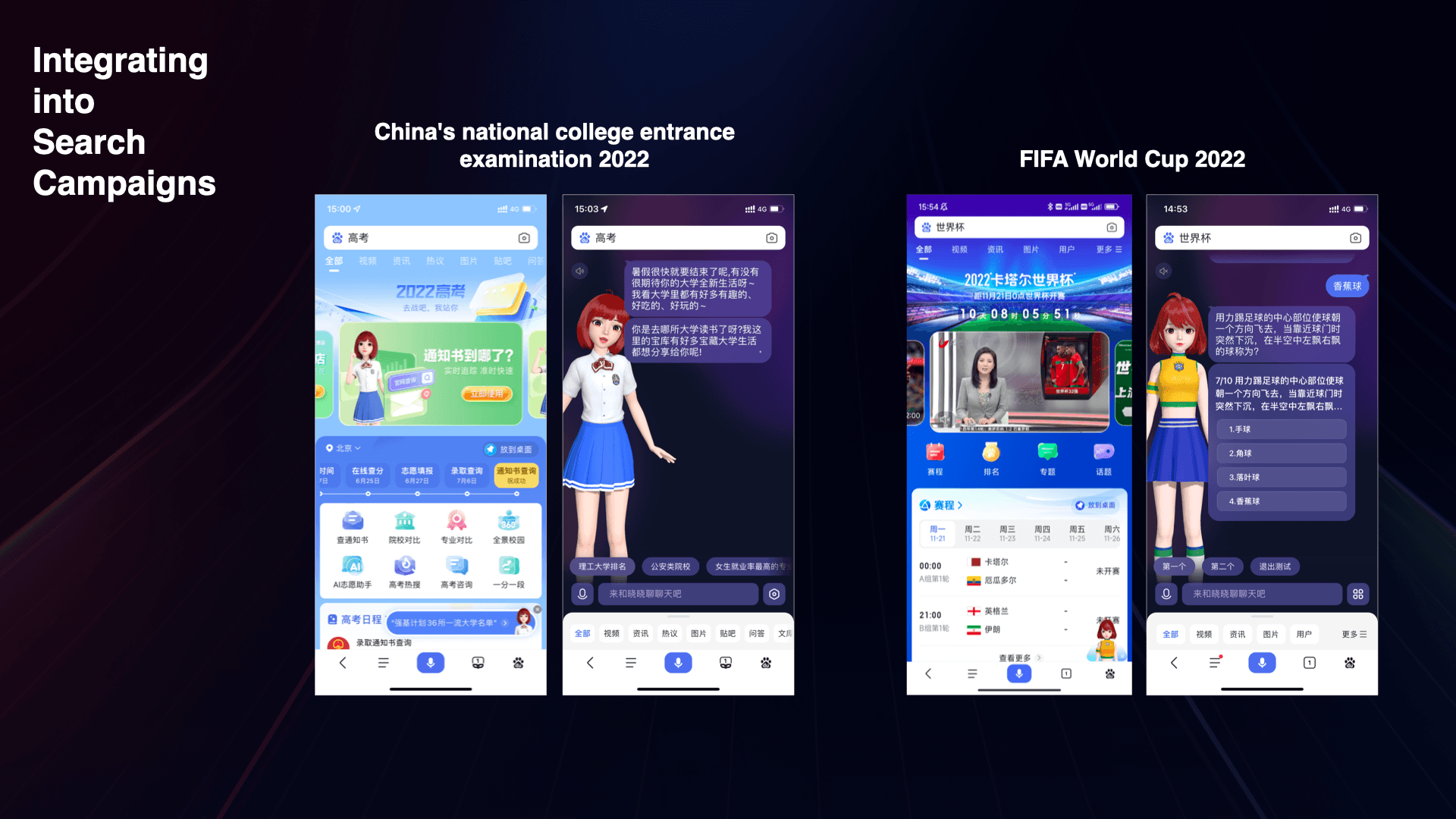
We also developed event-based information experiences around major events such as the Gaokao, China's national college entrance examination, and the FIFA World Cup. Duxiaoxiao not only served as the campaign spokesperson but also answered questions and provided information and guidance through conversation, making the experiences more engaging and participatory. We added interactive formats such as knowledge-based quiz games to make interactions more enjoyable and sustained while staying within the technical capabilities of the time.
Making Interaction More Expressive
Designing multimodal interaction for an AI virtual human assistant required coordinating rendering, vocal tone, facial expressions, body motion, and audiovisual effects to convey emotion and atmosphere. It also required choosing carefully between AI-driven behavior and authored choreography based on the maturity of each technology.
The engine's rendering quality directly shaped the character's realism and expressiveness. We worked closely with engineering to test different baking, lighting, shader, and shadow techniques. Within the performance constraints of mobile devices, we repeatedly balanced visual quality against runtime efficiency, gradually improving the appearance of skin, hair, clothing, and environmental lighting so Duxiaoxiao could feel more natural and vivid while continuing to run smoothly.
Facial expression was the most direct way to convey emotion and a major factor in whether communication felt natural. I studied the relationship between expression and speech and divided facial expressions into two categories: supporting expressions used while speaking, and standalone expressions inserted between spoken phrases. They served different purposes and required different implementation methods.
Supporting expressions needed to continuously align with meaning, vocal tone, and lip movement. Before we introduced AI-driven facial animation, manual choreography could not cover the volume of dialogue or respond effectively to vocal tone in real time. Working closely with speech engineers, we repeatedly adjusted the weights of key expression states and the deformation range of the character's blend shapes. This established a foundation for training the facial-animation model, allowing Duxiaoxiao to coordinate facial expression, vocal tone, and lip sync automatically for more natural responses. Standalone expressions could be more emotionally impactful, but they depended heavily on the specific conversational context and were difficult to generate reliably. We therefore continued to use template matching and authored choreography for them.
Body motion could further communicate the character's intent and emotion, but full-body animation involved more variables and was shaped by meaning, timing, and spatial context. High-quality AI-driven motion was therefore much harder to achieve and remained primarily authored. We continued expanding Duxiaoxiao's motion library around common use cases and triggered those animations through dialogue templates, allowing her body language to better match the content of each interaction.
Atmosphere was another important part of emotional expression. A digital screen gave us more freedom to enhance it visually and sonically. We designed effects such as hearts and fireworks, then choreographed them around key moments in conversations. This made emotional expression more vivid and interactions more engaging and memorable.
Together, these design improvements helped Duxiaoxiao fit naturally into real user journeys while steadily increasing the quality and expressiveness of the interaction. They supported growth in both total interactions and conversational turns. Ultimately, Duxiaoxiao served tens of millions of users and accumulated billions of conversations in Baidu App, providing production-scale data for evaluating the value of virtual human interaction. Similar products that later entered the market also provided further evidence that anthropomorphic, multimodal AI interaction was a direction worth exploring.
2. Virtual Idol: Elevating the Character
During Phase Two, the growing interest in the metaverse made virtual humans a popular vehicle for brand marketing and content. Duxiaoxiao began receiving substantial public attention and opportunities for commercial partnerships. This went beyond the project's original expectations. Her early design had primarily supported real-time AI assistant interaction and interchangeable outfits; it had not been created for the visual demands of promotional videos, brand campaigns, or large live events. Both the rendering technology and character fidelity had limitations. We therefore began systematically elevating Duxiaoxiao's visual design and worked closely with marketing and monetization teams so she could support higher-quality brand expression.
Improving Rendering Quality
Rendering quality directly affected the virtual idol's realism and visual appeal in high-quality content. I guided the team in improving hair, skin materials, cloth simulation, lighting, and rendering fidelity, giving Duxiaoxiao a more refined and expressive visual presence while preserving her defining character traits.
Upgrading the Character Design
Duxiaoxiao had originally been designed as an approachable AI assistant with interchangeable outfits. Her base design was simple and friendly, but lacked enough visual presence for major events and brand partnerships. We retained her defining red hair and blue-and-white color palette while redesigning her face, hairstyle, body proportions, and clothing. The result was a more fashionable and refined character better suited to live events and brand communication.
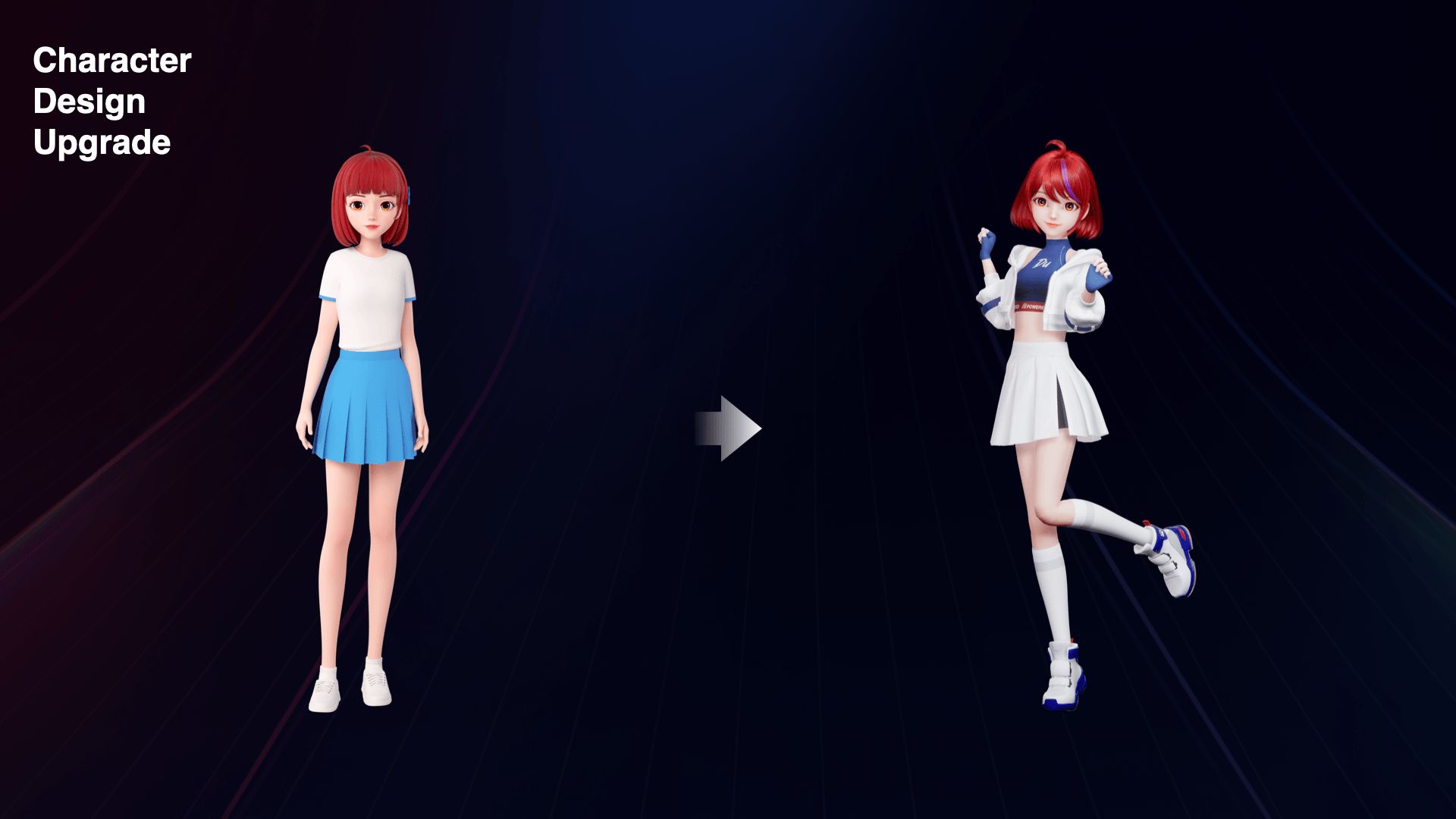
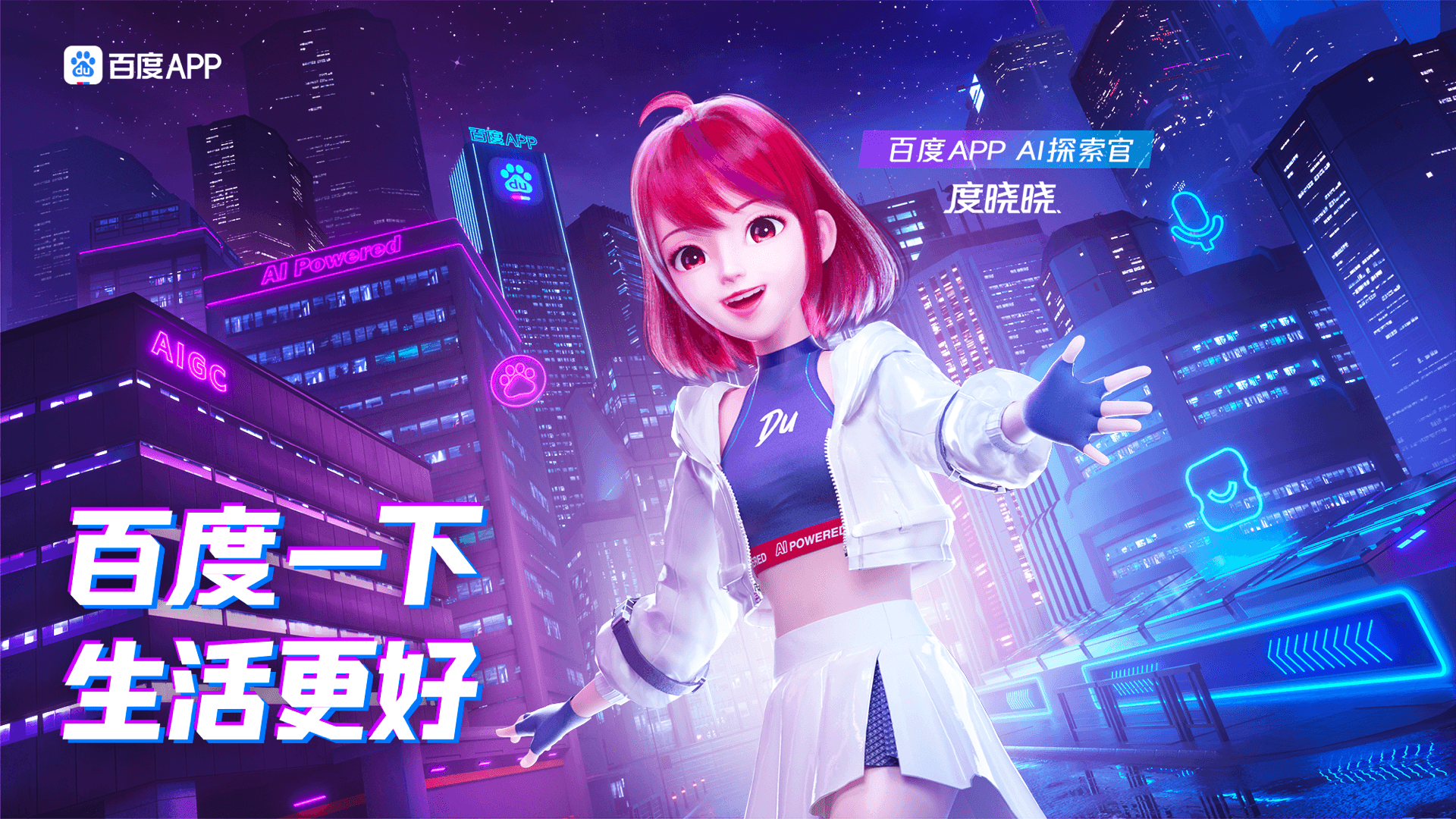
These improvements helped Duxiaoxiao evolve from an in-product AI assistant into a virtual idol with broader market recognition. They increased public awareness and partnership value, and helped her rank among the leading virtual humans in several industry research reports. The resulting market attention also brought more users and interactions back to Duxiaoxiao inside Baidu App.
3. Infrastructure: Turning Production into Tools
As Duxiaoxiao's market recognition grew, demand for brand campaigns and commercial partnerships increased quickly. Building a dedicated production team for every request would not have been cost-effective or scalable. We therefore shifted the focus of the 3D team toward building character-production tools and defining shared standards, while business teams and external production partners handled the content itself. We created a character asset platform, a video production platform, and a live production system so Duxiaoxiao could be used more efficiently and consistently across different contexts.
Character Asset Platform
Many internal and external collaborations required teams to locate and transfer assets and align on production specifications. We organized Duxiaoxiao's base models, body motions, facial expressions, outfits, environments, effects, and props into a centralized platform, with clear usage standards and technical requirements. Partner teams could find and request the assets they needed directly, reducing duplicate production and significantly improving communication and collaboration efficiency.
Character Video Production Platform
Many internal and external video requests followed repeatable formats, including educational explainers, event announcements, and marketing content. These requests did not require a professional 3D team to produce every video individually; they primarily required flexible combinations of existing character assets. We therefore built an internal web-based production platform where users could choreograph Duxiaoxiao's dialogue, facial expressions, body motion, and outfits, then generate video assets. The backend reused the Unreal Engine assets and rendering capabilities established by the design team, increasing production efficiency while maintaining consistent visual quality.
Character Live Production System
Live streaming was another important format for Duxiaoxiao's events and brand partnerships. Fully AI-driven live performance was not mature enough at the time, so we used human performers to drive the character in real time. The system reused the same Unreal Engine assets and rendering capabilities, mapping a performer's facial expressions and body motion onto Duxiaoxiao through cameras and motion-capture sensors. It also supported flexible switching between environments, camera angles, and interactive content, making virtual human live production more reliable and efficient.
All three systems were built on shared character assets, production standards, and technical capabilities. Together, they maintained Duxiaoxiao's visual quality and consistency across partnerships while significantly increasing production efficiency and the team's capacity to support new business. This infrastructure supported a large number of brand partnerships and RMB 100M-level commercial revenue.
This completed the core work of Phase Two. Duxiaoxiao ultimately served tens of millions of users and accumulated billions of conversations in Baidu App. She also supported billions of brand impressions and RMB 100M-level commercial revenue, validating the potential of a virtual human as an AI product, a character asset, and a commercial platform.
Although Duxiaoxiao demonstrated the value of virtual humans for emotionally expressive interaction and companionship, that value did not align closely with Baidu's stronger focus on utility-driven AI and efficiency-oriented use cases. The conversational technology of the time also struggled with complex requests and multi-turn context, while smartphones were not the ideal form factor for multimodal virtual human interaction. As interest in the metaverse declined, the commercial outlook weakened, and LLMs demonstrated greater potential, the team shifted toward LLM + search in 2023, and further investment in Duxiaoxiao ended.
Insights and Reflections
Although further investment in Duxiaoxiao ended in 2023, the experience was invaluable. It expanded the boundaries of my practice and gave me direct experience designing a consumer AI product. It also shaped several broader lessons about design:
1. Designers Need to Understand Technology
A strong industrial designer needs to understand the characteristics of materials, how they are manufactured, and the limits of what they can do. In the same way, digital product designers need to understand technology as a material. On Duxiaoxiao, understanding natural language processing, speech, real-time rendering, and AI-driven behavior was essential to judging which experiences were feasible, where authored solutions were still needed, and how to balance quality, performance, and cost. Technical understanding not only improves design judgment; it also helps translate technology into product value that users can actually experience.
2. Designers Need to Grow from Specialists into Domain Experts
Mastering the craft of design is the foundation of professional value. But to create designs that better serve users, products, and businesses in practice, designers need to broaden their boundaries. They need to understand the relevant technology, industry dynamics, business goals, and resource constraints, then build domain-specific knowledge and judgment over time. This allows designers to contribute across the end-to-end process, from setting direction and defining the experience to cross-functional delivery and continuous iteration, and ultimately create greater value for both the product and the business.
3. Move from Solving Today's Problems to Exploring Better Futures
Solving immediate problems is one of the most important ways designers create value. Exploratory design offers another path: proactively and systematically addressing long-term and emerging problems, and sometimes preventing problems before they occur. Designing for possible futures requires a broader understanding of social trends, technological progress, industry shifts, organizational capabilities, and user needs. Designers must form evidence-based hypotheses amid uncertainty, translate a vision into testable product paths, and use continued practice and validation to turn exploration into real-world value.
This is the design story behind Duxiaoxiao, an AI virtual human assistant. The experience was a systematic exploration of consumer AI products in the pre-LLM era, and gave me practical experience and perspective on how AI might interact with people and what that relationship could become.
In 2026, LLMs, multimodal models, and AI agents have moved AI into a new product paradigm centered on conversational interaction, autonomous understanding, and task execution. Yet personal AI assistants that can truly understand people over time, build trust, and become part of everyday life, along with the relationship people may form with them, are still being explored and validated. I believe the experience and questions that Duxiaoxiao left behind will continue to offer value in this deeper exploration.

